Periodic Signals (Continuous & Discrete) – Concepts, Conditions & GATE Tricks
Periodic signals form the backbone of signal processing, communication, and electronics. Any signal that repeats itself after a fixed interval is called periodic. From AC waveforms to digital sequences, periodicity helps us simplify analysis using powerful tools like Fourier Series. If you truly understand this topic, many GATE questions become direct scoring.
Keywords: periodic signals, continuous-time periodic signals, discrete-time periodic signals, fundamental period of a signal, periodic vs aperiodic signals, sum of periodic signals, GATE ECE signals and systems, signal periodicity examples, LCM condition discrete signals
Continuous vs Discrete Periodic Signals (Core Differences)
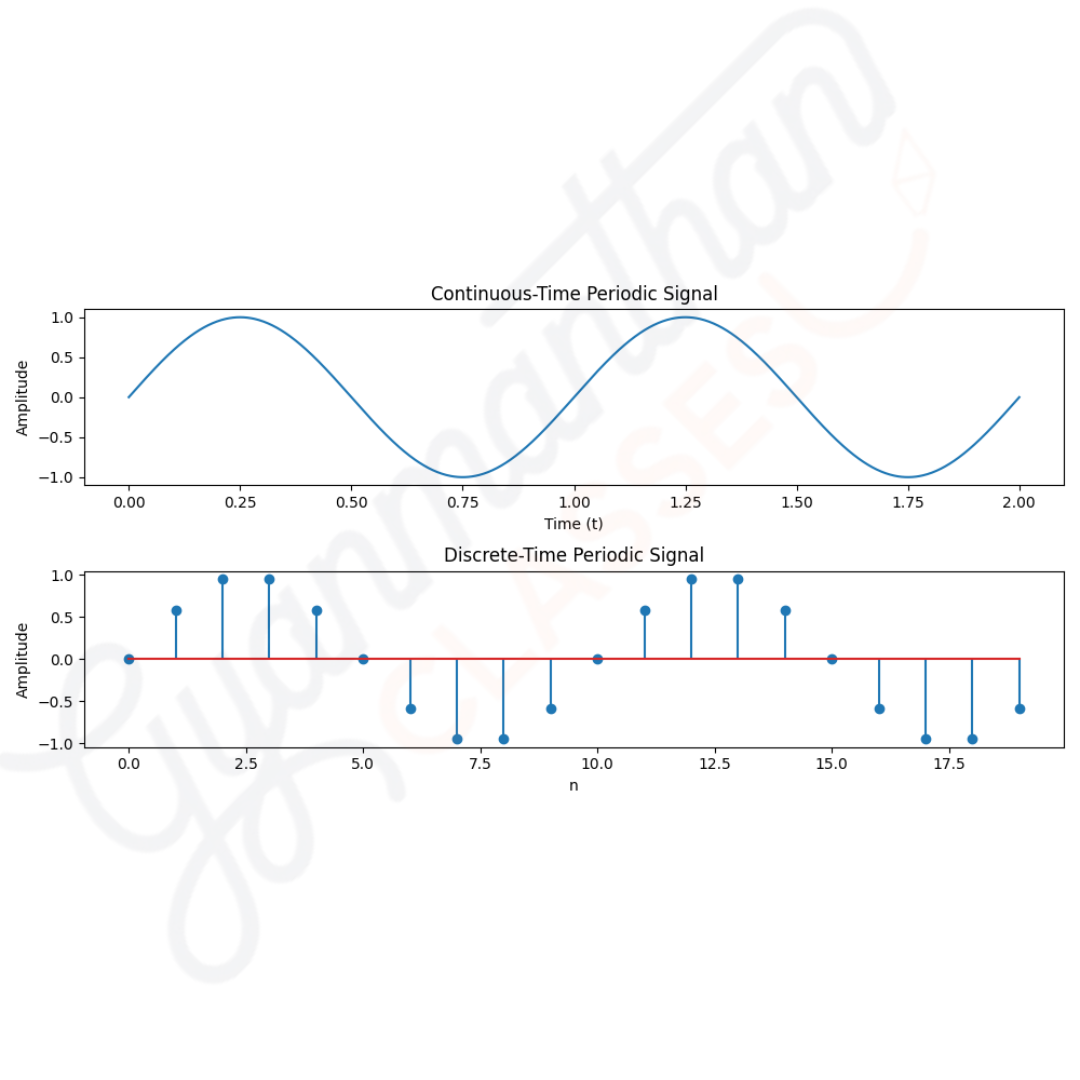
- Continuous-time signals repeat after time T
- Discrete-time signals repeat after N samples
- CT signals are always periodic for sinusoidal inputs
- DT signals are periodic only if frequency is rational
- Fundamental period must be smallest possible value
| Feature | Continuous-Time | Discrete-Time |
|---|---|---|
| Definition | x(t) = x(t + T) | x[n] = x[n + N] |
| Period | Any real value (T) | Integer only (N) |
| Example | sin(2πt) | cos(πn/2) |
| Important Condition | Always periodic (for sinusoids) | ω / 2π must be rational |
GATE-Level Insights & Common Mistakes
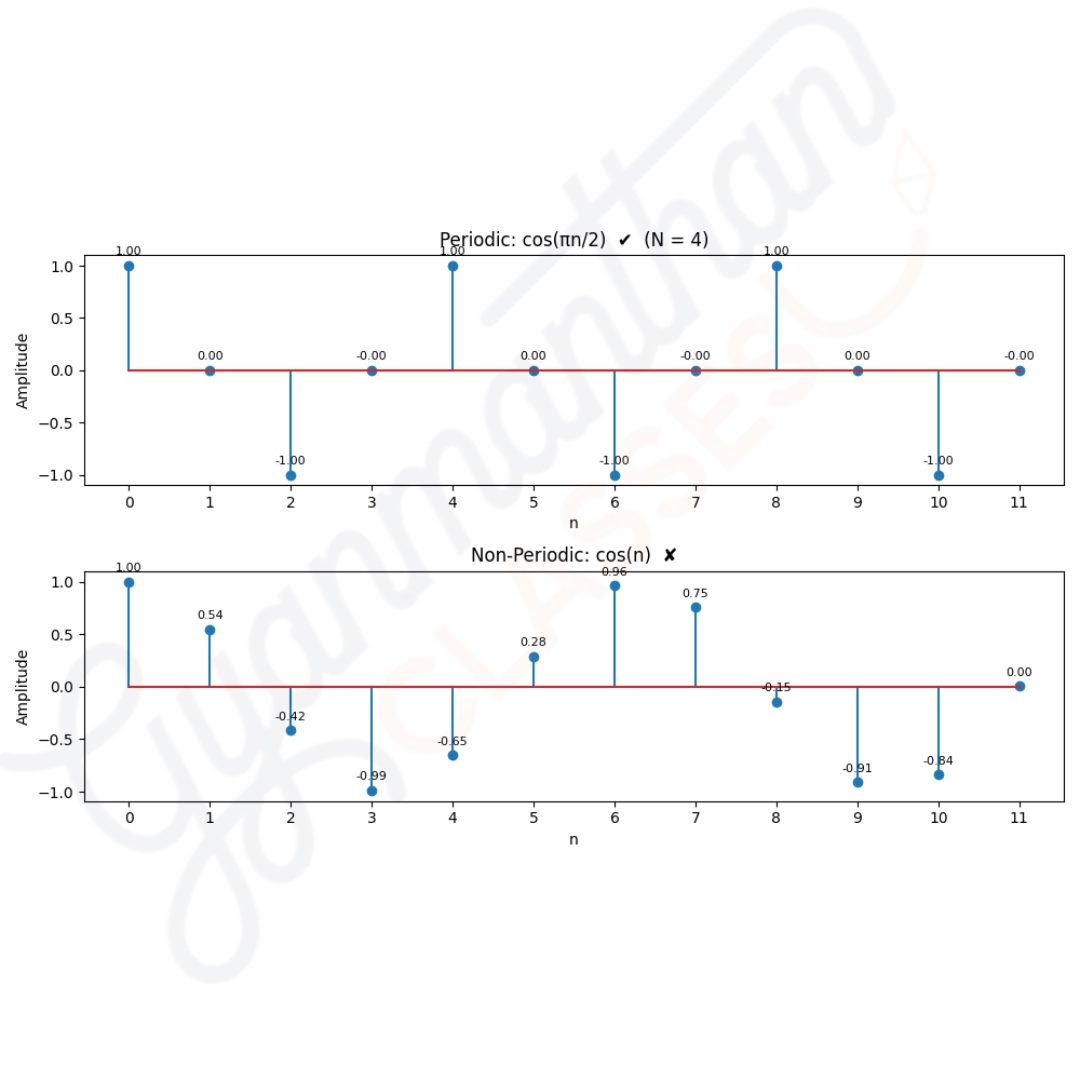
- DT signal like cos(n) is NOT periodic ❌
- Check ω / 2π carefully before assuming periodicity
- Fundamental period is always the smallest valid value
- Combination of periodic signals may NOT be periodic
- LCM concept is used when multiple periods exist
| Signal | Periodic? | Reason |
|---|---|---|
| cos(πn/2) | Yes | ω/2π = 1/4 (rational) |
| cos(n) | No | ω/2π is irrational |
| sin(2πt) | Yes | Always periodic in CT |
| sin(t) + cos(√2 t) | No | No common period |
Period of Sum of Two Signals (Continuous vs Discrete)
When two periodic signals are added, the result is not always periodic. The key idea is whether both signals repeat together after some common interval.
For Continuous-Time Signals:
If two signals have fundamental periods $T_1$ and $T_2$, then:
Resultant signal is periodic only if $$\frac{T_1}{T_2} \text{ is rational}$$
In that case, overall period: $$T = \mathrm{LCM}(T_1, T_2)$$
Example: $$\sin(2\pi t) + \cos(4\pi t)$$
Here, $$T_1 = 1, \quad T_2 = \frac{1}{2}$$
Since $\frac{T_1}{T_2} = 2$ (rational), signal is periodic.
Overall period:
$$T = \mathrm{LCM}(1, \tfrac{1}{2}) = 1$$
For Discrete-Time Signals:
If signals have periods $N_1$ and $N_2$, then:
Both signals must be individually periodic.
Overall period: $$N = \mathrm{LCM}(N_1, N_2)$$
Example: $$\cos\left(\frac{\pi n}{2}\right) + \cos\left(\frac{\pi n}{3}\right)$$
Here, $$N_1 = 4, \quad N_2 = 6$$
Overall period: $$N = \mathrm{LCM}(4, 6) = 12$$
⚠️ Important: If even one signal is non-periodic, the sum is always non-periodic.




Discussion / Comments