Energy and Power Signals in Continuous and Discrete Time
Signals are broadly classified into energy signals and power signals based on how their magnitude behaves over time. This classification helps in understanding whether a signal is transient or persistent in nature. It is a fundamental concept in Signals and Systems and is frequently asked in GATE due to its direct application in signal analysis and communication systems.
Keywords: energy and power signals, energy signal examples, power signal examples, continuous and discrete signals energy power, finite energy infinite power, average power calculation signals, GATE ECE signals and systems, signal classification
Energy Signal (Concept Explanation)
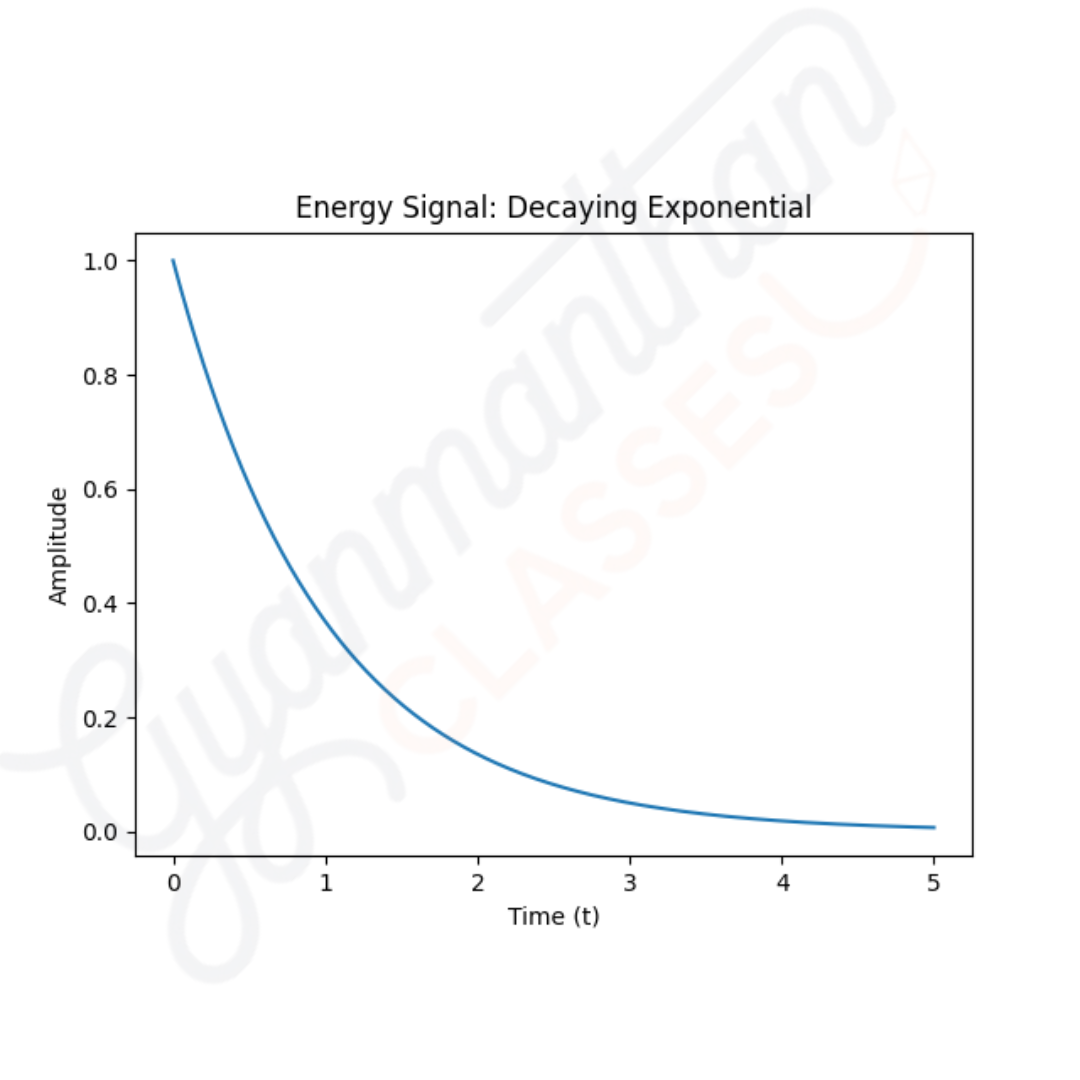
An energy signal is one whose total energy remains finite over the entire time duration. These signals typically exist for a short period and gradually decay to zero as time progresses.
In practical terms, energy signals represent transient phenomena, meaning they do not last forever. After a certain duration, their effect becomes negligible.
For Continous Signals: $$ E = \int_{-\infty}^{\infty} |x(t)|^2 \, dt $$
For Discrete Signals:$$ E = \sum_{n=-\infty}^{\infty} |x[n]|^2 $$
Key Characteristics:
- Signal amplitude decreases over time
- Exists for a limited duration
- Total accumulated effect is bounded
- Common in pulse-type signalsq
Power Signal (Concept Explanation)
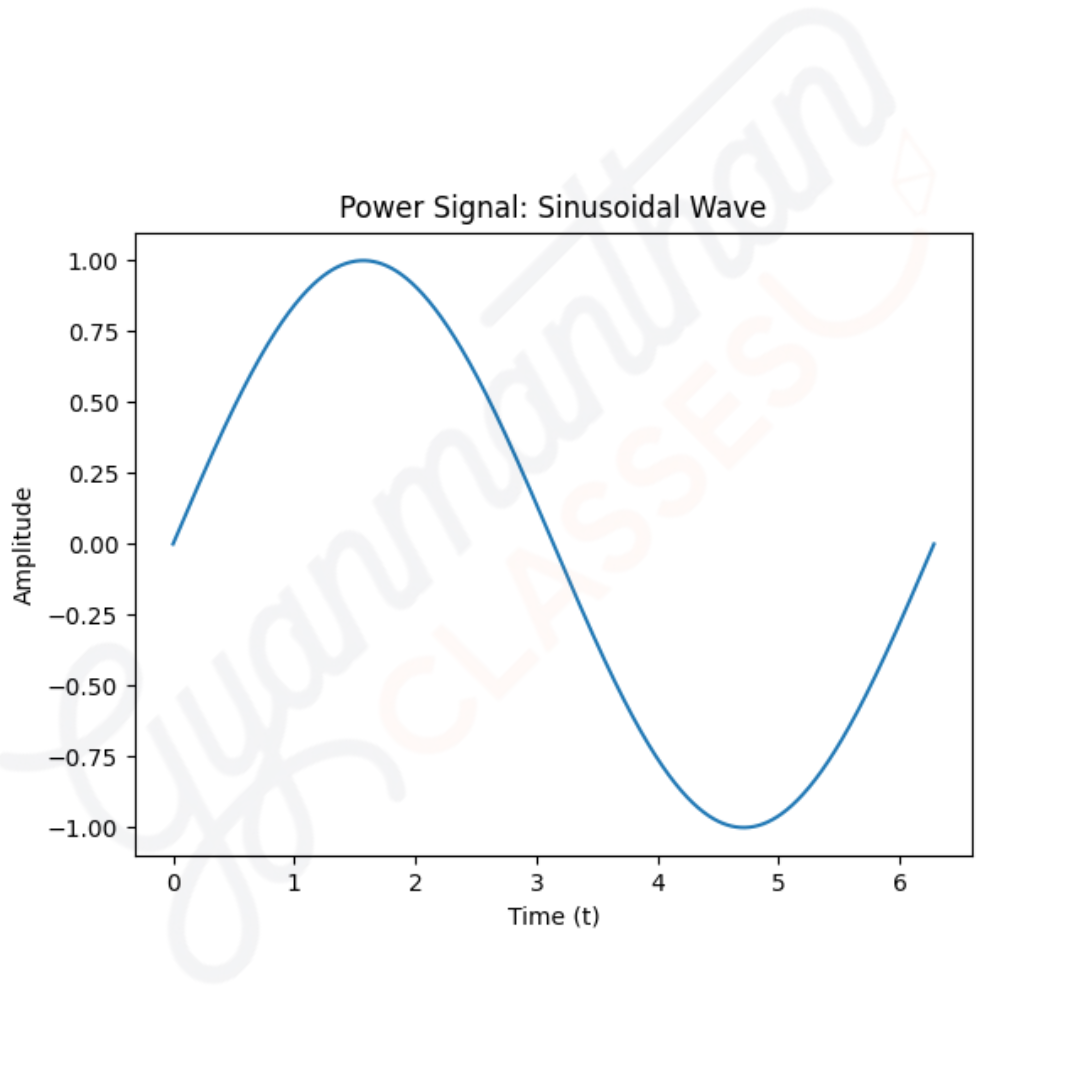
A power signal is one that indefinitely over time and maintains a consistent level of strength. Instead of having finite total energy, these signals have a finite average power.
Such signals are generally periodic or steady-state in nature, meaning they do not decay and continue to exist for all time.
ForContinous Signals:$$ P = \lim_{T \to \infty} \frac{1}{2T} \int_{-T}^{T} |x(t)|^2 \, dt $$
For Discrete Signals:$$ P = \lim_{N \to \infty} \frac{1}{2N+1} \sum_{n=-N}^{N} |x[n]|^2 $$
Key Characteristics:
- Signal does not vanish over time
- Exists for infinite duration
- Has consistent long-term behavior
- Common in sinusoidal and periodic signals




Discussion / Comments