Fourier Series for Signals and Systems
Fourier Series is a fundamental tool for representing a periodic signal as a sum of sinusoids. In GATE ECE, questions frequently test Fourier coefficients, trigonometric and exponential forms, symmetry properties, Parseval's theorem, convergence, and signal reconstruction.
Understanding Fourier Series is essential because it provides a powerful way to analyze periodic signals in the frequency domain. By identifying signal symmetry and applying the right Fourier Series properties, many GATE problems can be solved quickly with minimal calculation.
In this chapter, Fourier Series concepts are explained with mathematical derivations, intuitive interpretations, solved examples, shortcut techniques, and GATE-oriented practice problems. By the end, you will be able to find Fourier coefficients and analyze periodic signals efficiently.
Keywords: Fourier Series, Trigonometric Fourier Series, Exponential Fourier Series, Fourier Coefficients, Fourier Series Properties, Symmetry Properties, Parseval's Theorem, Fourier Series Convergence, GATE ECE Signals and Systems
Fourier Series Representation
Fourier Series represents a periodic signal as a sum of sinusoidal components. Depending on the symmetry and nature of the signal, the Fourier coefficients can be simplified, making the analysis of periodic signals easier and faster.
Trigonometric vs Exponential Fourier Series
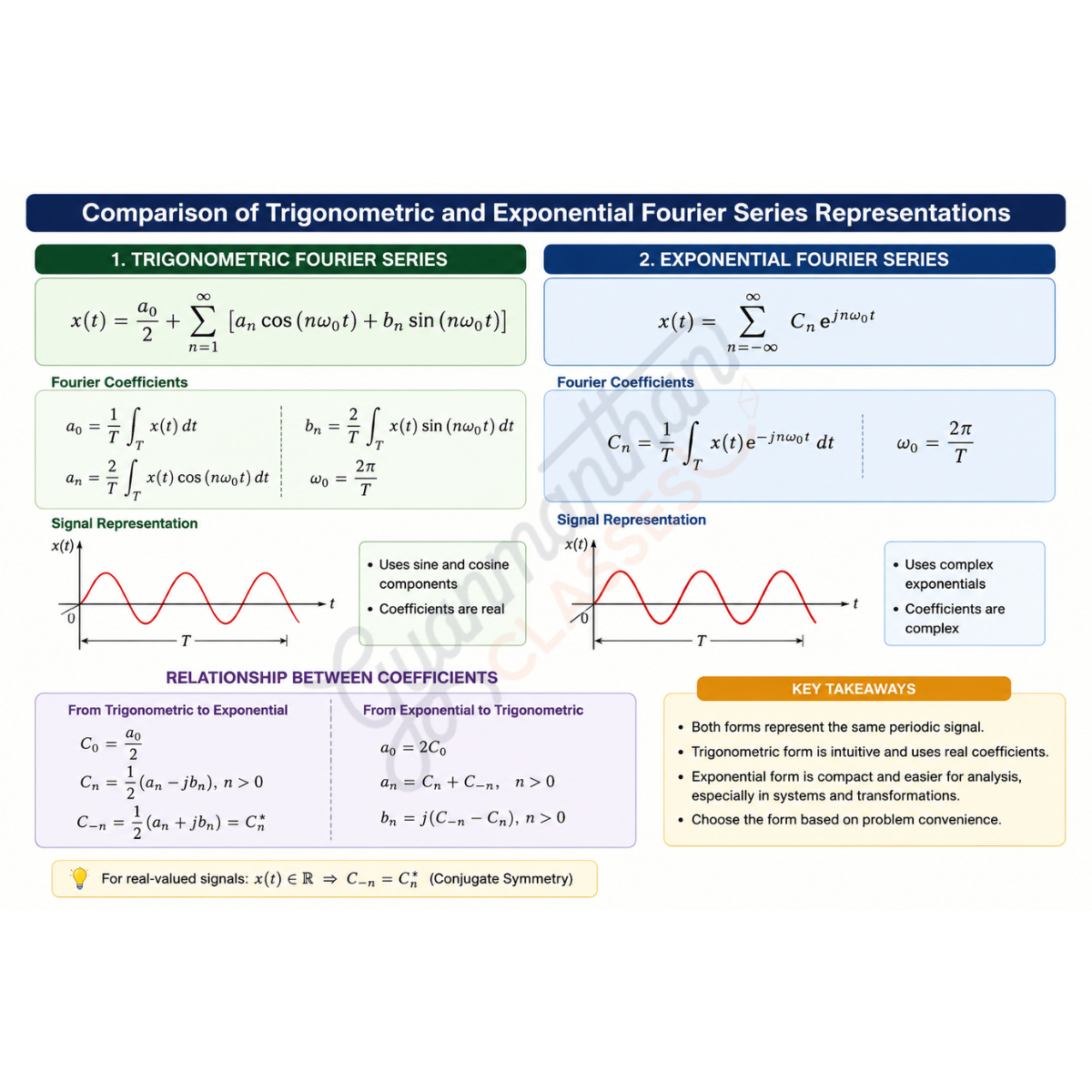
A periodic signal can be represented using either the trigonometric Fourier Series or the exponential Fourier Series. Both forms provide the same signal representation, but the exponential form is often more compact and convenient for mathematical analysis.
Fourier Series Forms
Trigonometric Form:
$x(t)=\frac{a_0}{2}+\sum_{n=1}^{\infty} \left[a_n\cos(n\omega_0t)+b_n\sin(n\omega_0t)\right]$
Exponential Form:
$x(t)=\sum_{n=-\infty}^{\infty}C_ne^{jn\omega_0t}$
Key Characteristics
- Both forms represent the same periodic signal.
- Trigonometric form uses sine and cosine components.
- Exponential form uses complex exponentials and is often simpler for analysis.
- Signal symmetry can significantly simplify the calculation of Fourier coefficients.
- Choosing the appropriate form is important for solving GATE problems efficiently.
Fourier Series Quick Reference
| Concept | Key Result |
|---|---|
| Fundamental Frequency | $\omega_0=2\pi/T$ |
| DC Component | $a_0/2$ |
| Trigonometric Form | DC + Sine + Cosine terms |
| Exponential Form | Complex exponential representation |
| Even Signal | $b_n=0$ |
| Odd Signal | $a_0=a_n=0$ |
| Half-Wave Symmetry | Even harmonics vanish |
| Parseval's Theorem | Power = Sum of harmonic powers |
| Real Signal | $C_{-n}=C_n^*$ |




Discussion / Comments