Continuous & Discrete-Time Signals – Concepts, Examples & GATE Tricks
Continuous and discrete-time signals form the backbone of signal processing in GATE ECE. Understanding their differences, fundamental periods, and key examples like unit step, impulse, and sinusoidal signals is crucial for scoring in the exam.
Continuous-Time Signals (CT Signals)
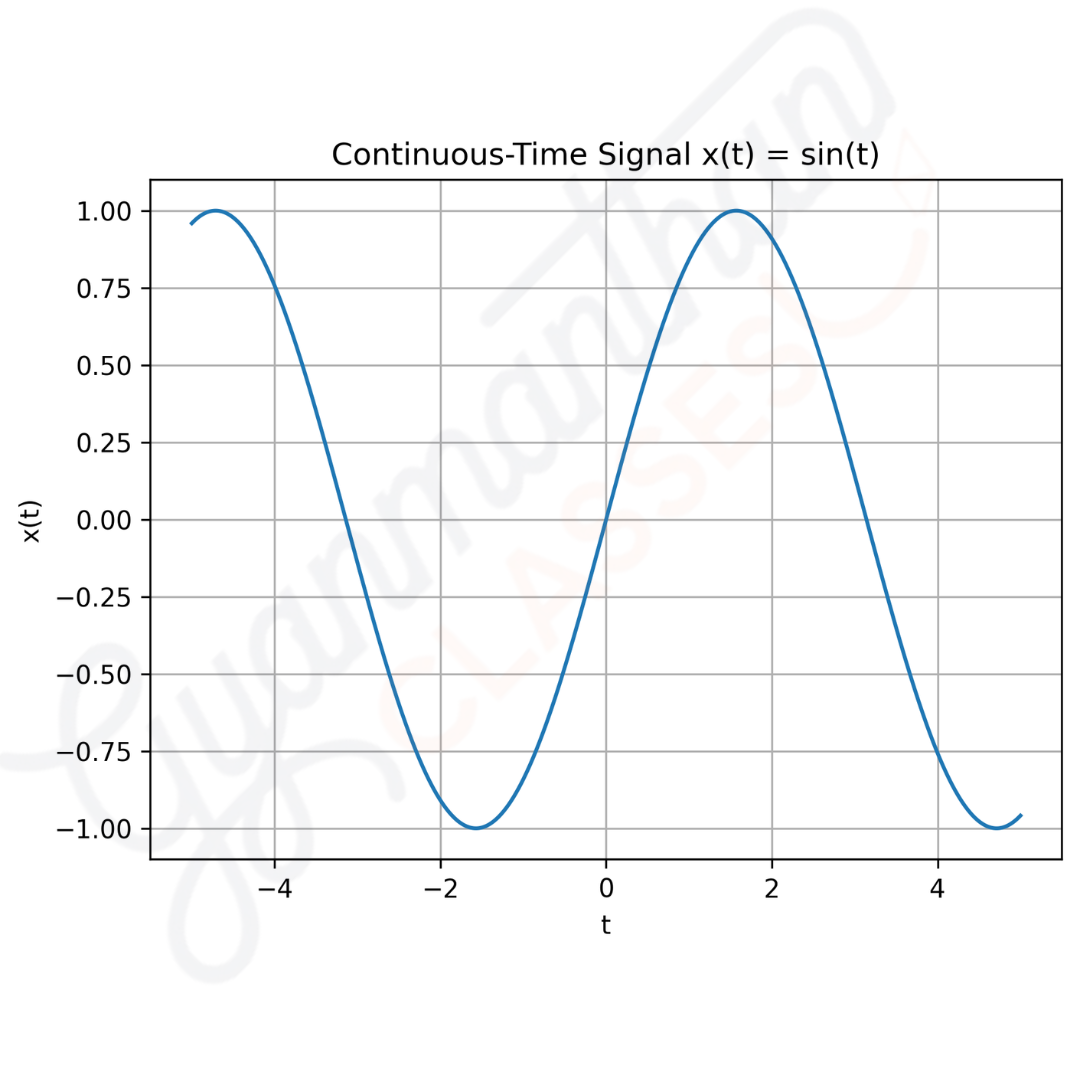
A continuous-time signal is defined for all values of time t. Common examples include analog signals like ECG, audio, and temperature variations.
- Unit step signal: $u(t)$
- Unit impulse (Dirac) signal: $\delta(t)$
- Ramp signal: $r(t)$
- Sinusoidal signal: $x(t) = A \cos(\omega t + \phi)$
- Exponential signal: $x(t) = A e^{st}$
Fundamental period: For a sinusoidal CT signal $x(t) = A \cos(\omega t + \phi)$, period $T$ is $$T = \frac{2\pi}{\omega}$$
⚠️ GATE Tip: Only signals where $\frac{\omega_1}{\omega_2}$ is rational are periodic when summed.
Discrete-Time Signals (DT Signals)
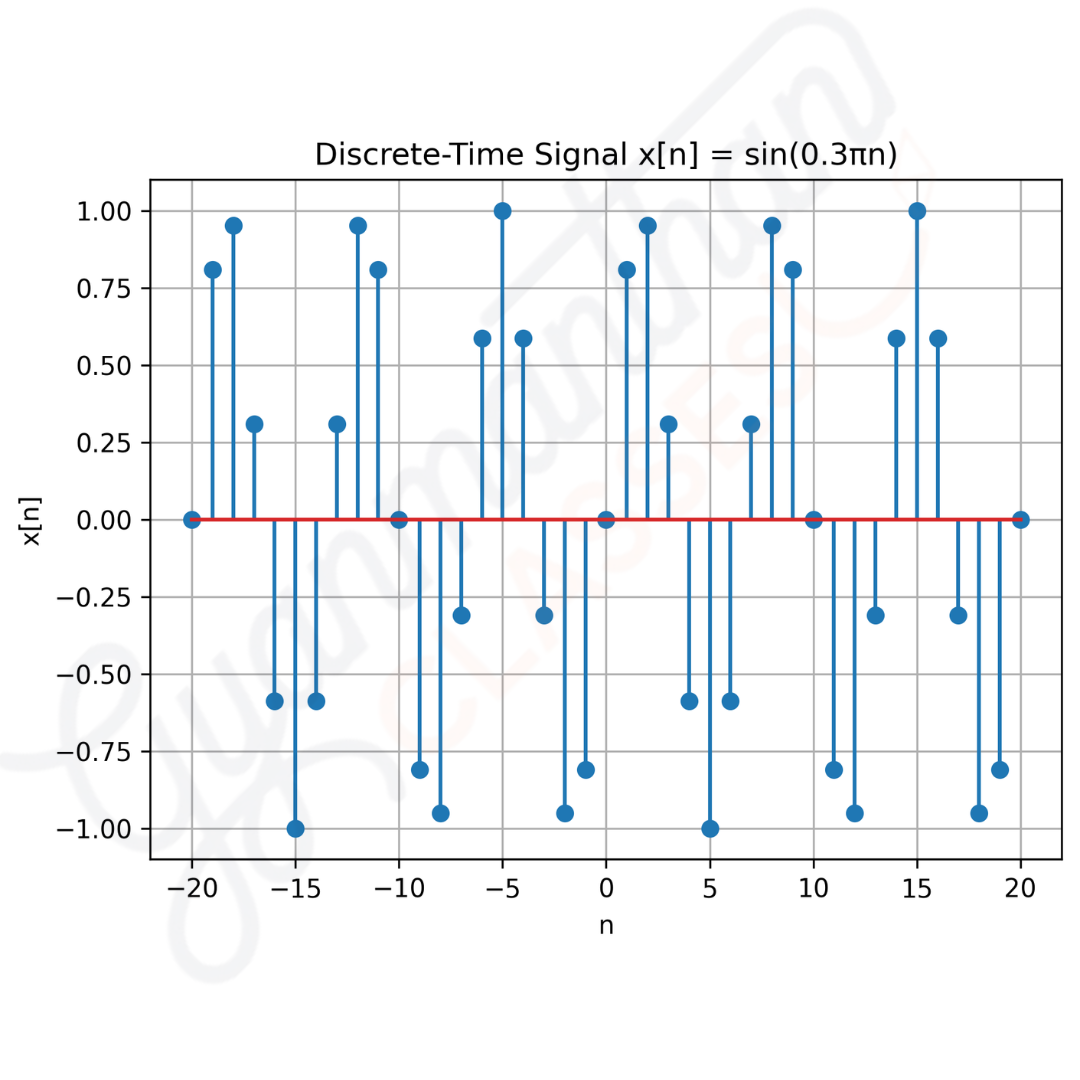
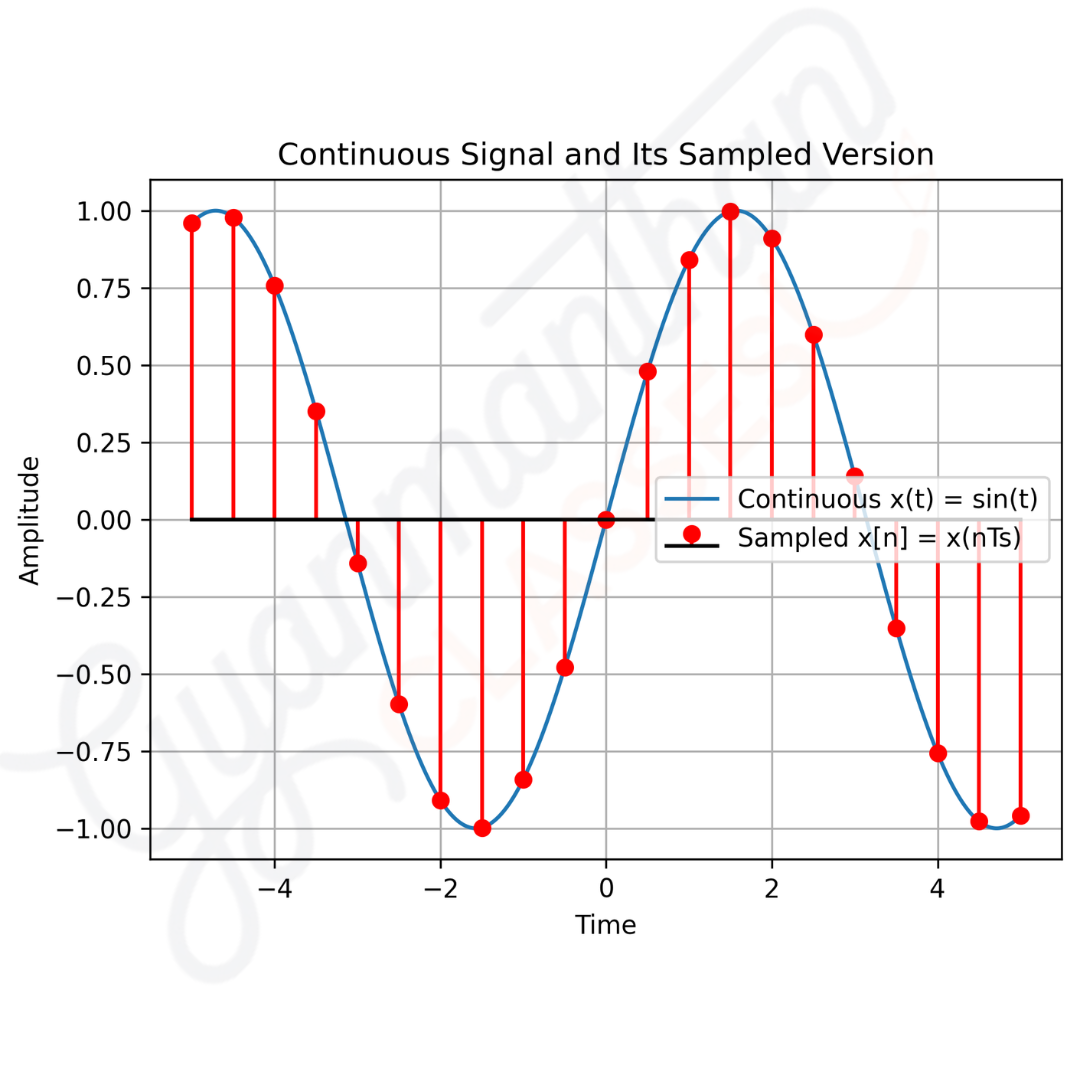
A discrete-time signal is defined only at integer values of n. These signals are obtained by sampling continuous-time signals or exist naturally in digital systems.
- Unit step: $u[n]$
- Unit impulse: $\delta[n]$
- Sinusoidal: $x[n] = A \cos(\omega_0 n + \phi)$
- Exponential: $x[n] = A \alpha^n$
Fundamental period: For a DT sinusoid $x[n] = A \cos(\omega_0 n + \phi)$, it is periodic if $\omega_0 / (2\pi) = \text{rational} \Rightarrow x[n+N] = x[n]$ and the period $N$ is the smallest integer satisfying this.
⚠️ GATE Tip: Discrete-time sinusoids may appear non-periodic for some $\omega_0$ even if it looks sinusoidal. Check rational condition carefully.
| Signal | Expression | Fundamental Period |
|---|---|---|
| CT Sinusoid | $x(t) = \cos(2\pi t)$ | $T = 1$ |
| CT Sinusoid | $x(t) = \cos(4\pi t)$ | $T = 0.5$ |
| DT Sinusoid | $x[n] = \cos(\pi n / 2)$ | $N = 4$ |
| DT Sinusoid | $x[n] = \cos(\pi n / 3)$ | $N = 6$ |
Continuous vs Discrete Signals – Quick Comparison
- CT signals: defined for all real t; DT signals: defined for integer n
- CT sinusoid always periodic; DT sinusoid periodic only if $\omega_0/2\pi$ is rational
- CT sum of sinusoids: periodic if ratio of frequencies rational; DT sum: period = LCM(N1,N2)
- GATE Tip: Carefully check DT signal periods, many students make mistakes assuming all DT sinusoids are periodic
Example – Period of Sum (DT): $$x[n] = \cos(\pi n/2) + \cos(\pi n/3)$$ $$\Rightarrow N = LCM(4,6) = 12$$




Discussion / Comments