Coulomb’s Law in Electrostatics | Force Between Point Charges (GATE ECE EMFT)
Coulomb’s Law is the most fundamental law of electrostatics that explains how force acts between two point charges. It forms the foundation of EMFT and is one of the most important and frequently asked topics in GATE ECE.
Advanced concepts like Electric Field, Electric Potential, and Gauss’s Law are directly built on this law, making it essential for mastering electrostatics.
Keywords: Coulomb’s law EMFT, electrostatic force formula, inverse square law, point charge interaction, permittivity, GATE ECE electrostatics
Coulomb’s Law Statement
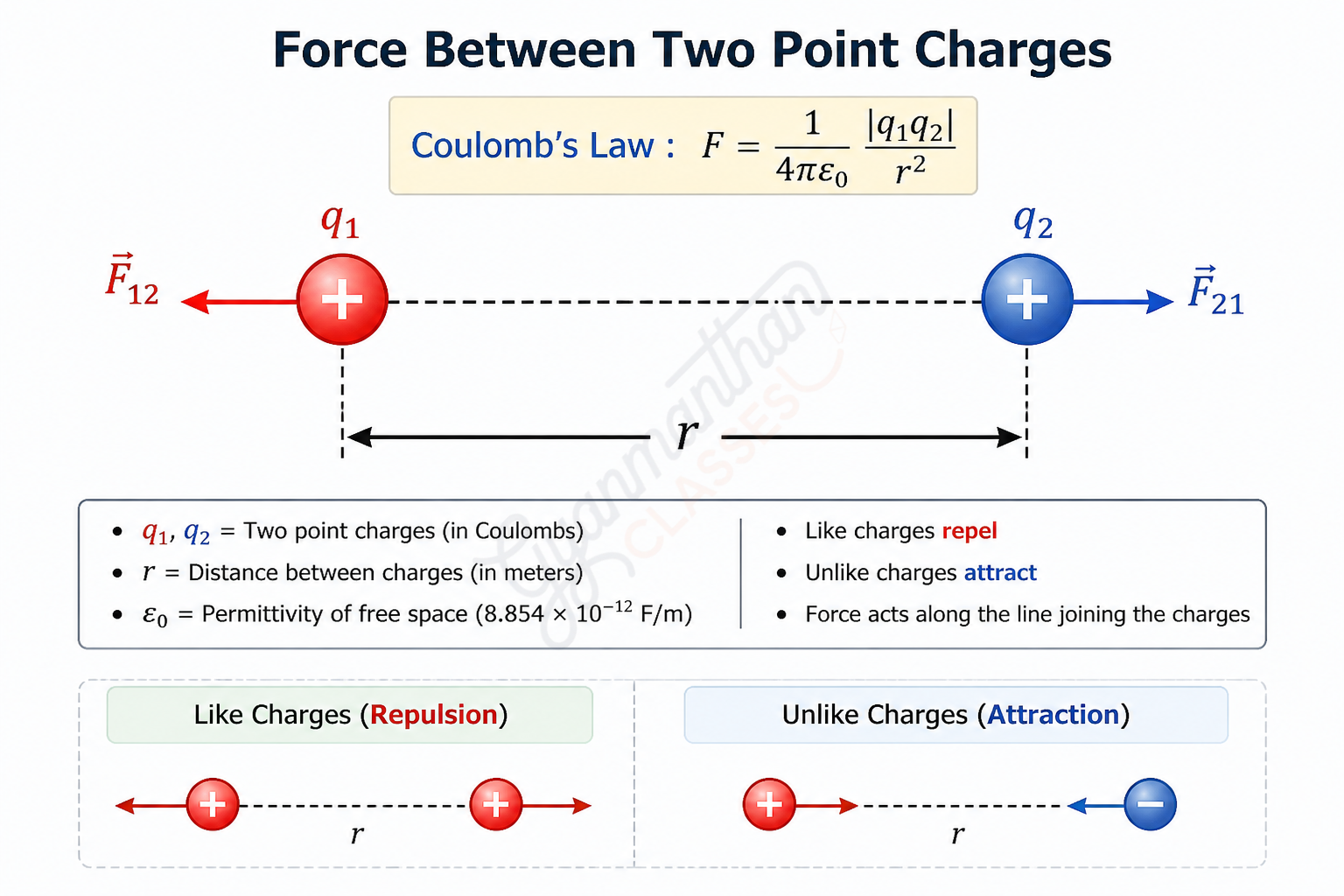
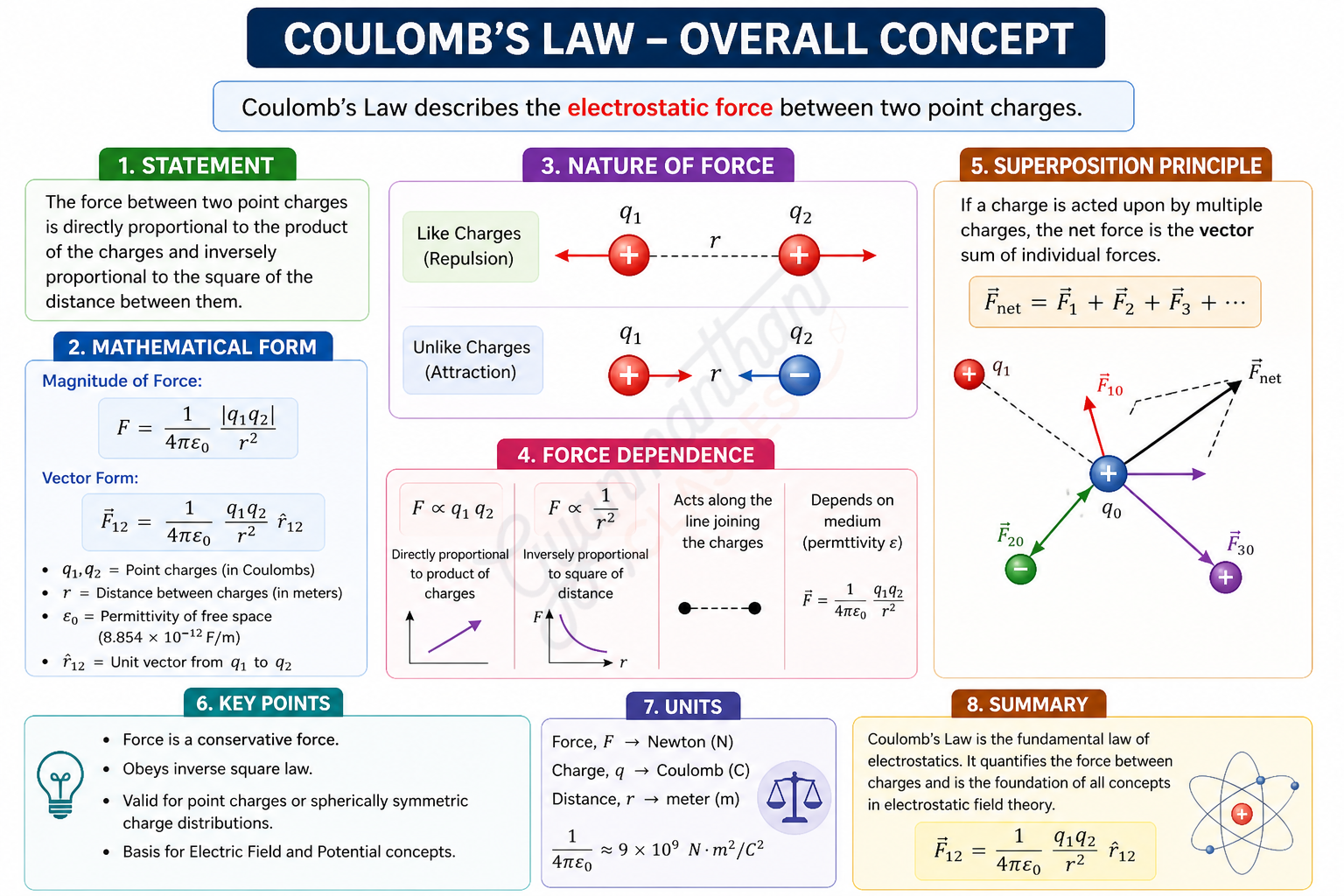
The force between two point charges is directly proportional to the product of their charges and inversely proportional to the square of the distance between them.
$$ F \propto \frac{q_1 q_2}{r^2} $$
Final Formula:
$$ F = \frac{1}{4\pi\varepsilon_0}\frac{q_1 q_2}{r^2} $$
Key Points:
- The force acts along the line joining the two charges.
- Like charges → repulsion
- Unlike charges → attraction
- It follows the inverse square law.
Click to zoom-in
Vector Form of Coulomb’s Law
Since force is a vector quantity, its direction is also important.
$$ \vec{F}_{12} = \frac{1}{4\pi\varepsilon_0}\frac{q_1 q_2}{r^2}\hat{r}_{12} $$
Meaning:
- $\hat{r}_{12}$ represents the direction of the force.
- The force always acts along the line joining the charges.
Effect of Medium (Permittivity)
The force decreases when the medium changes due to the effect of permittivity.
$$ F = \frac{1}{4\pi\varepsilon}\frac{q_1 q_2}{r^2} $$
Where:
- ε = permittivity of medium
- ε₀ = permittivity of free space
- ε = ε₀εr
Superposition Principle
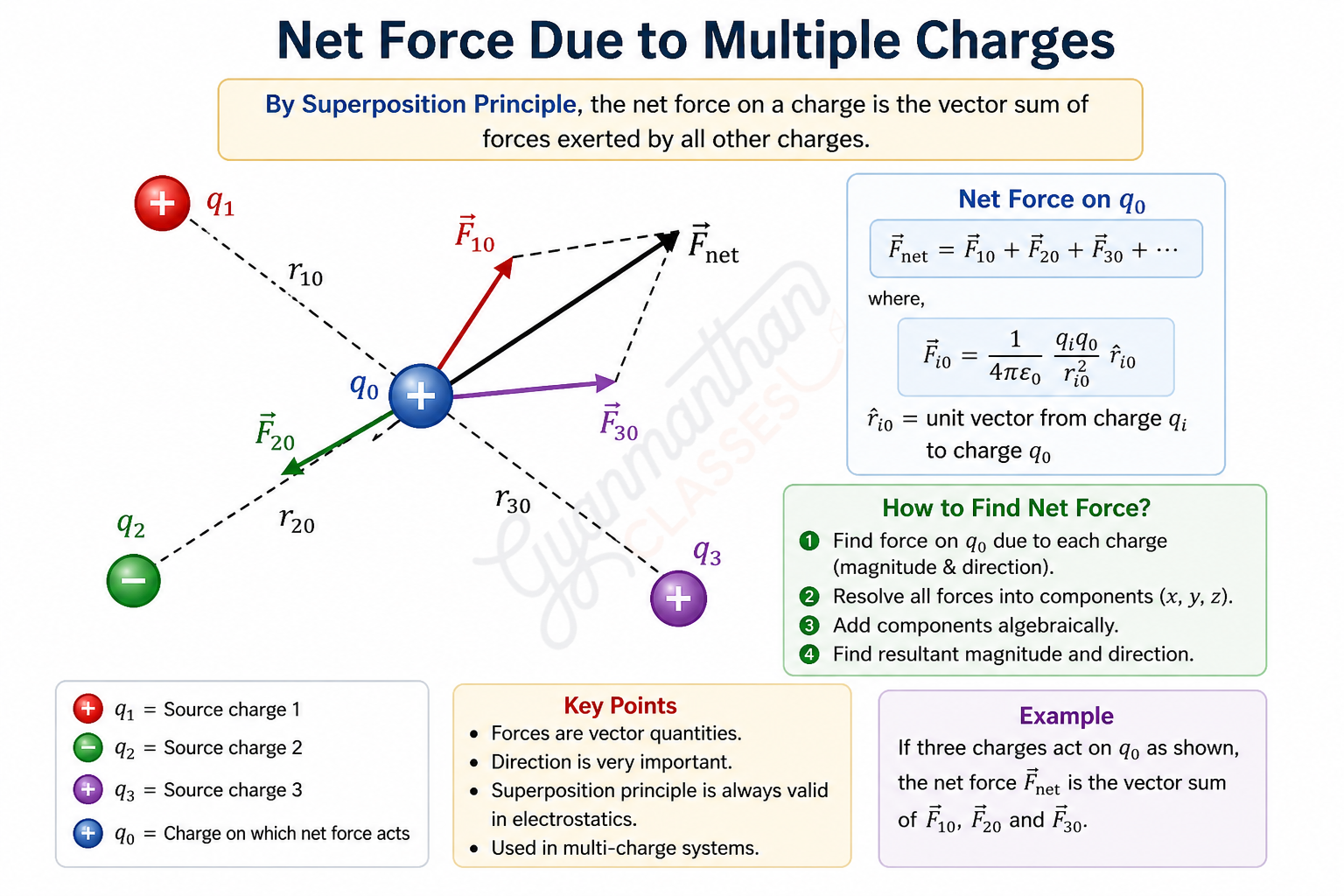
When multiple charges are present, the net force is the vector sum of all individual forces.
$$ \vec{F}_{net} = \vec{F}_1 + \vec{F}_2 + \vec{F}_3 + \cdots $$
Key Points:
- Forces are added in vector form.
- Considering direction is mandatory.
Nature of Force
| Charges | Nature | Result |
|---|---|---|
| Same sign | Repulsive | Push apart |
| Opposite sign | Attractive | Pull together |
Coulomb’s Law vs Gravitational Law
| Feature | Coulomb’s Law | Gravitation |
|---|---|---|
| Source | Electric charge | Mass |
| Nature | Attractive + Repulsive | Only Attractive |
| Medium effect | Yes | No |
GATE Level Insights
- Vector direction is most important
- Superposition frequently asked
- Dielectric medium concepts common
- Multi-charge systems are standard questions
Common Mistakes
- Scalar addition instead of vector addition
- Wrong direction of force
- Ignoring permittivity of medium
- Sign confusion in charges
Final Summary
Coulomb’s Law forms the foundation of electrostatics by explaining the interaction between electric charges and serves as the basis for advanced EMFT concepts.
$$ F = \frac{1}{4\pi\varepsilon_0}\frac{q_1 q_2}{r^2} $$
Click to zoom-in




Discussion / Comments