Electric Field and Field Lines | Electrostatics Fundamentals (GATE ECE EMFT)
Electric Field is a fundamental concept of electrostatics that describes the region around a charge where another charge experiences an electric force. Instead of calculating force directly between charges every time, the concept of electric field provides a more convenient way to analyze electrostatic interactions.
Electric Field Lines are imaginary lines used to visualize the magnitude and direction of the electric field in space. These concepts form the basis of advanced topics such as Electric Flux, Gauss's Law, and Electric Potential.
Keywords: electric field EMFT, electric field intensity, field lines, electric field due to point charge, electrostatics, GATE ECE EMFT
Electric Field and Field Lines | Electrostatics Fundamentals (GATE ECE EMFT)
Electric Field is a fundamental concept in electrostatics that describes the region around a charge where another charge experiences an electric force. It provides a convenient way to analyze interactions between charges without directly applying Coulomb’s Law every time.
Electric Field Lines are imaginary lines used to visualize the magnitude and direction of the electric field in space. Understanding field lines is extremely important for topics like Gauss’s Law, Electric Flux, and Potential.
Keywords: electric field EMFT, electric field intensity, electric field lines, electrostatics, field due to point charge, GATE ECE electrostatics
Electric Field Definition
The electric field at a point is defined as the force experienced by a unit positive test charge placed at that point.
$$ \vec{E} = \frac{\vec{F}}{q} $$
Where:
- E = Electric field intensity (N/C)
- F = Force acting on test charge
- q = Test charge
Key Points:
- Electric field is a vector quantity.
- Its direction is the direction of force on a positive test charge.
- Unit: N/C or V/m.
Click to zoom-in
Electric Field Due to a Point Charge
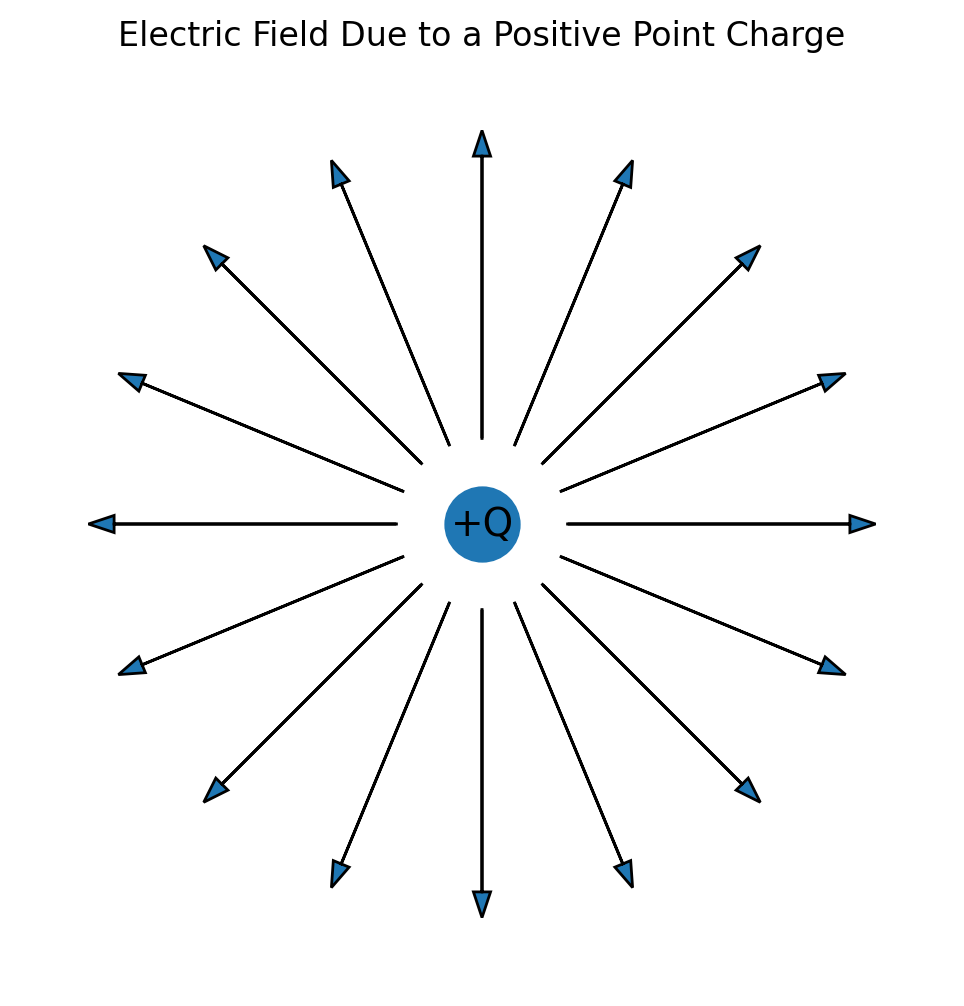
Using Coulomb’s Law, the electric field produced by a point charge at distance r is:
$$ \vec{E} = \frac{1}{4\pi\varepsilon_0}\frac{Q}{r^2}\hat{r} $$
Observations:
- Field decreases with square of distance.
- Field is radially outward for positive charge.
- Field is radially inward for negative charge.
Electric Field Lines
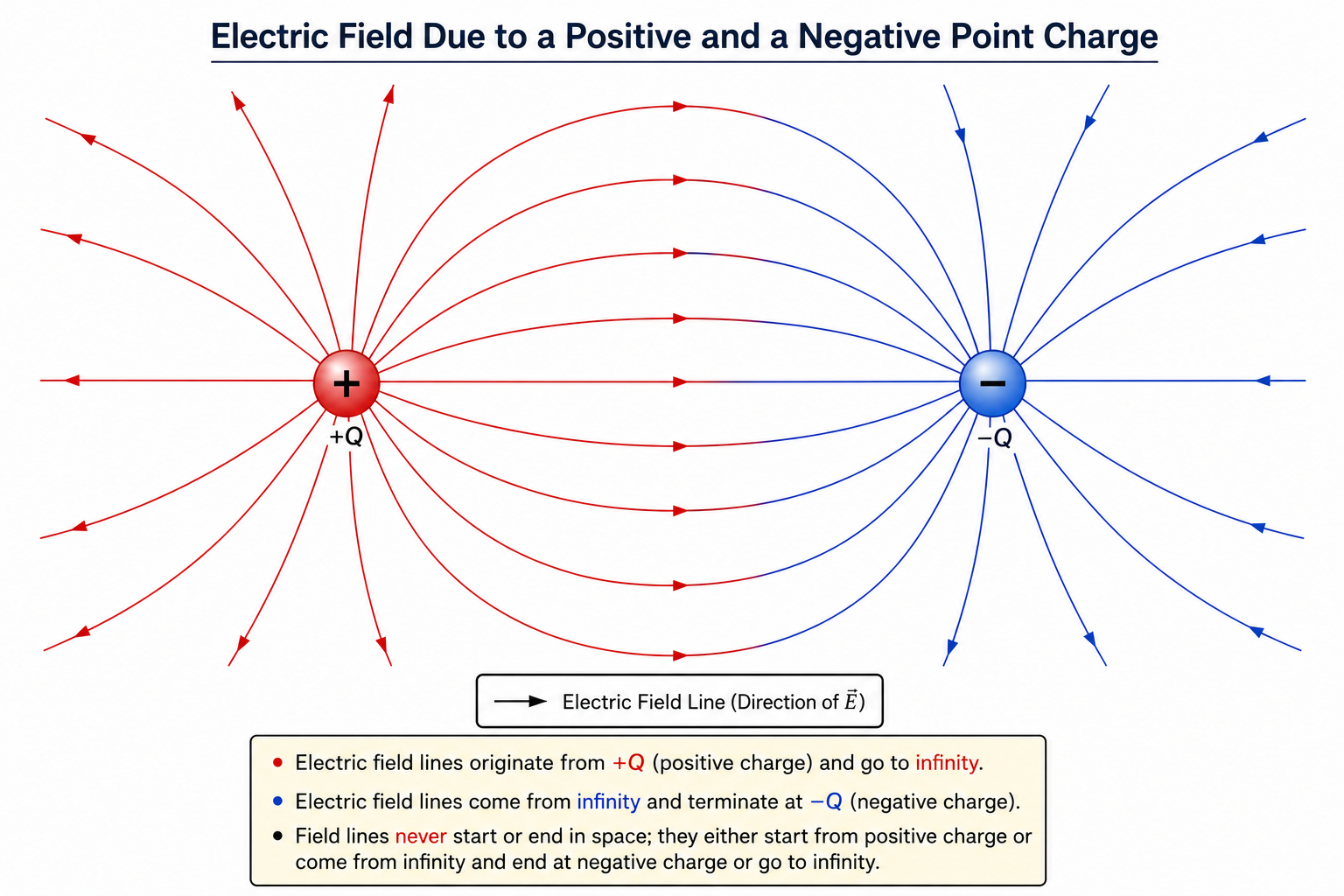
Electric field lines are imaginary curves whose tangent at any point gives the direction of the electric field.
Purpose:
- Visualize field direction.
- Compare field strength at different regions.
- Understand charge distributions.
Important Rule:
The density of field lines indicates the strength of the electric field.
Properties of Electric Field Lines
- Field lines start from positive charges.
- Field lines terminate on negative charges.
- They never intersect each other.
- Closer lines indicate stronger field.
- Farther lines indicate weaker field.
- Field lines are always perpendicular to a conductor surface in electrostatic equilibrium.
Field Line Patterns
| Charge Configuration | Field Line Pattern |
|---|---|
| Positive Charge | Lines radiate outward |
| Negative Charge | Lines converge inward |
| Dipole | Lines start from + and end on − |
| Parallel Plates | Nearly uniform parallel lines |
Electric Field and Superposition
When multiple charges are present, the resultant electric field is the vector sum of individual electric fields.
$$ \vec{E}_{net} = \vec{E}_1 + \vec{E}_2 + \vec{E}_3 + \cdots $$
Key Points:
- Vector addition is mandatory.
- Direction must be considered.
- Field due to each charge is calculated independently.
Electric Field vs Electric Force
| Feature | Electric Field | Electric Force |
|---|---|---|
| Meaning | Property of space around charge | Actual interaction on charge |
| Depends on Test Charge | No | Yes |
| Unit | N/C | N |
GATE Level Insights
- Direction of electric field is frequently tested.
- Field line interpretation is a favorite conceptual topic.
- Superposition-based numericals are common.
- Field inside conductors is often asked.
Common Mistakes
- Confusing electric field with electric force.
- Using scalar addition instead of vector addition.
- Drawing intersecting field lines.
- Wrong direction for negative charges.
Final Summary
Electric field describes the influence of electric charges in space, while electric field lines provide a visual representation of the field’s magnitude and direction. These concepts serve as the foundation for Gauss’s Law, Electric Potential, and advanced EMFT topics.
$$ \vec{E} = \frac{1}{4\pi\varepsilon_0}\frac{Q}{r^2}\hat{r} $$




Discussion / Comments