System Characteristics in Signals and Systems
Every system possesses certain properties that describe how it responds to an input signal. These properties help us classify systems, predict their behavior, and determine the mathematical techniques that can be applied for analysis. In GATE ECE, questions frequently test whether a given system is memoryless or dynamic, linear or nonlinear, time invariant or time variant, causal or non-causal, stable or unstable, invertible or non-invertible, and deterministic or random.
Understanding these characteristics is essential because only systems satisfying specific properties—most importantly linearity and time invariance—can be analyzed using impulse response and convolution. Therefore, before studying LTI systems, one must first learn how to identify these properties from a given system equation.
In this chapter, each system property is explained with mathematical definitions, intuitive explanations, graphical interpretations, solved examples, shortcut identification techniques, and GATE-oriented practice problems. By the end of this chapter, you will be able to classify almost any continuous-time or discrete-time system by simply inspecting its input-output relationship.
Keywords: system characteristics, memoryless system, dynamic system, linear system, nonlinear system, time invariant system, time varying system, causal system, non causal system, BIBO stability, stable system, unstable system, invertible system, deterministic system, random system, LTI system, GATE ECE signals and systems
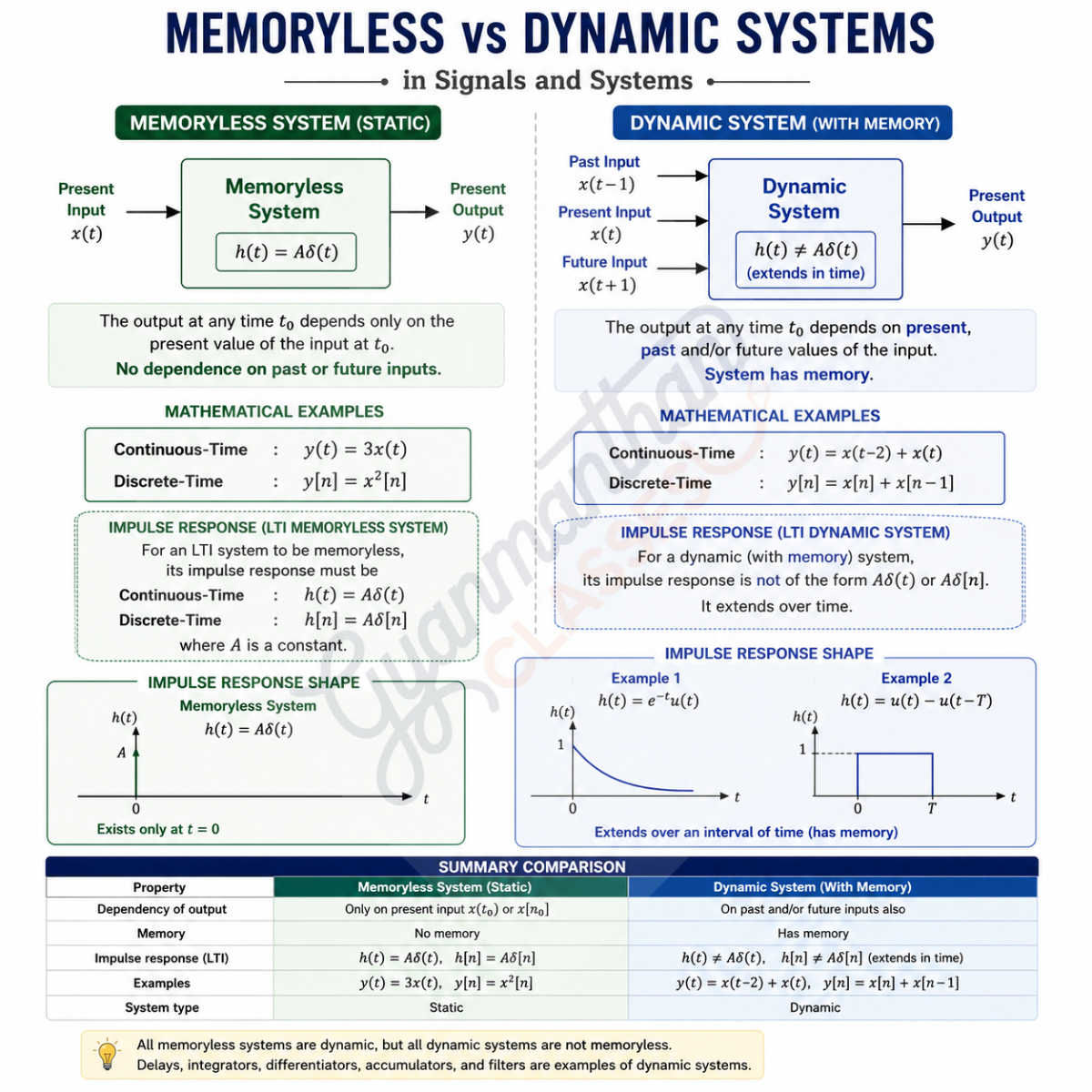
Memoryless vs Dynamic Systems
A system is classified as memoryless (static) or dynamic (with memory) depending on whether the present output depends only on the present input or also on input values from other time instants.
A memoryless system computes the output using only the current input sample. In contrast, a dynamic system requires knowledge of past and/or future input values to determine the present output.
For an LTI system to be memoryless, its impulse response must be of the form $h(t)=A\delta(t)$ and $h[n]=A\delta[n]$ for continous-time and discrete-time systems respectively, where A is a constant. Any impulse response extending over time indicates that the system has memory.
- Memoryless systems depend only on the present input.
- Dynamic systems depend on past, future, or accumulated input values.
- Differentiators, integrators, delays, and accumulators are dynamic systems.
- Most practical engineering systems possess memory.
Mathematical Examples
Memoryless:
Continuous-Time: $y(t)=3x(t)$
Discrete-Time: $y[n]=x^2[n]$
Dynamic:
Continuous-Time: $y(t)=x(t-2)+x(t)$
Discrete-Time: $y[n]=x[n]+x[n-1]$
Stable vs Unstable Systems (BIBO Stability)
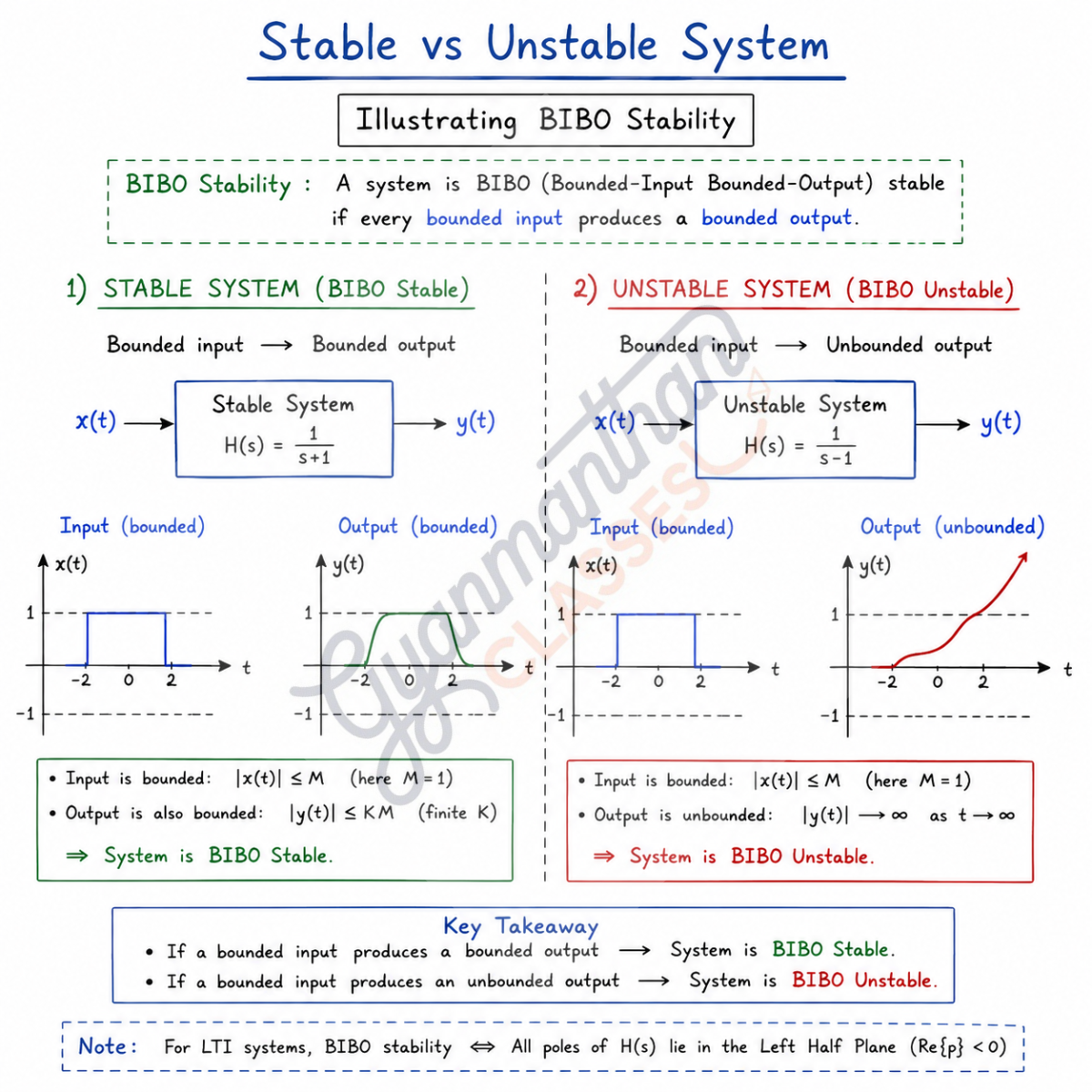
A system is said to be Bounded-Input Bounded-Output (BIBO) Stable if every bounded input always produces a bounded output. Stability is one of the most important properties in Signals and Systems because practical systems must operate without producing unbounded outputs.
Mathematically, if
$|x(t)|\le M_x <\infty,$
then the output must satisfy
$|y(t)|\le M_y <\infty.$
If a bounded input results in an unbounded output, the system is called unstable.
Examples
Stable:
$y(t)=2x(t)$
$y[n]=x[n]+x[n-1]$
Unstable:
$y(t)=e^tx(t)$
$y[n]=n\,x[n]$
Key Characteristics
- Every bounded input produces a bounded output.
- Unstable systems amplify bounded signals without limit.
- For LTI systems, stability depends on the impulse response.
- BIBO Stability is one of the most frequently tested GATE concepts.
Invertible vs Non-Invertible Systems
A system is called invertible if the original input can be uniquely recovered from the output using another system called the inverse system.
If different input signals produce the same output, the original input cannot be recovered uniquely, and the system is called non-invertible.
Mathematically, if
$y(t)=T\{x(t)\},$
then an inverse system satisfies
$T^{-1}\{y(t)\}=x(t).$
Examples
Invertible:
$y(t)=3x(t)$
Inverse:
$x(t)=\frac{y(t)}{3}$
Non-Invertible:
$y(t)=x^2(t)$
because both
$x(t)=2$ and $x(t)=-2$
produce the same output.
Key Characteristics
- Every output corresponds to exactly one input.
- Inverse system reconstructs the original signal.
- Many-to-one mappings are non-invertible.
- Square-law and absolute-value systems are common non-invertible examples.
Deterministic vs Random Systems
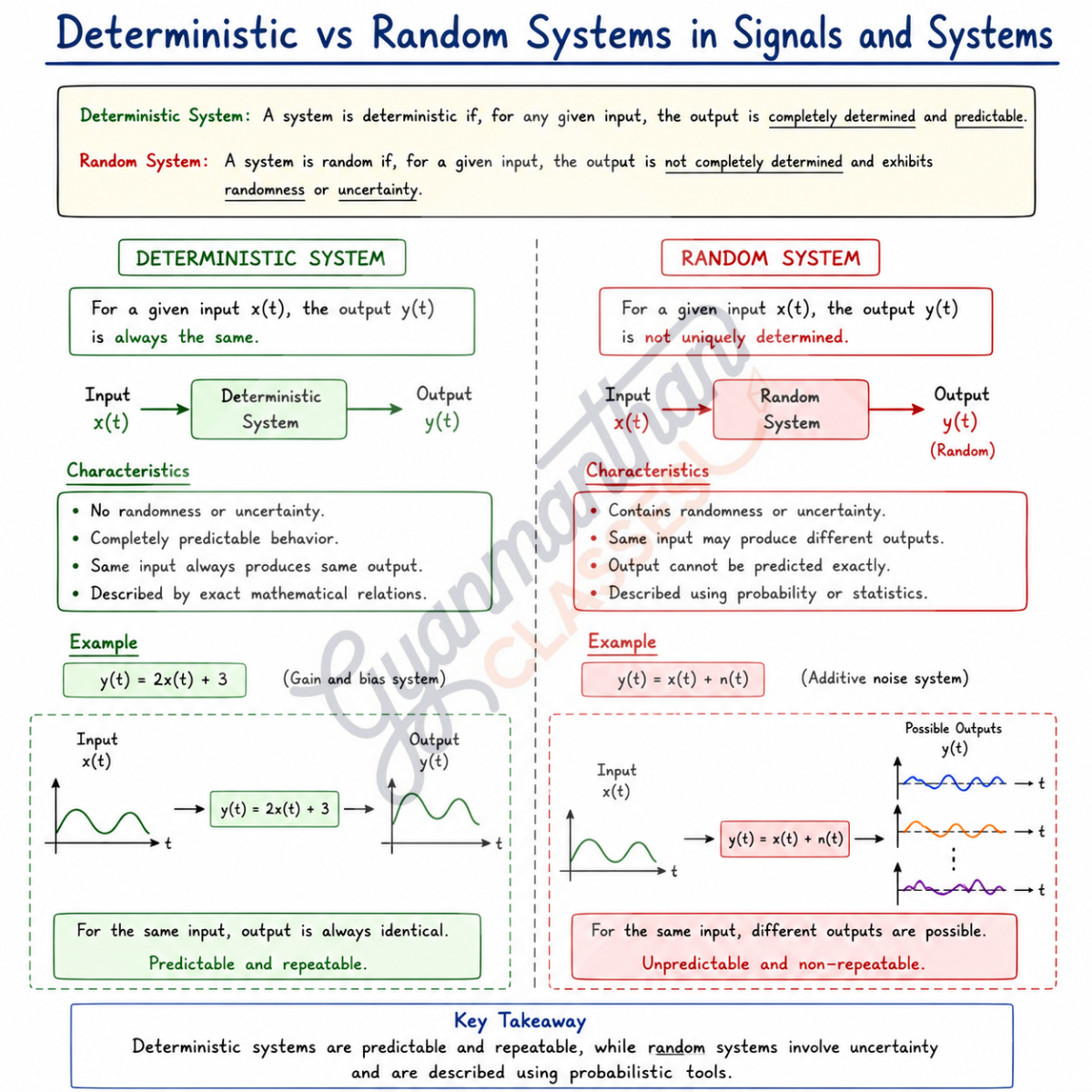
A deterministic system always produces the same output for a given input under identical operating conditions. Its behavior is completely defined by mathematical equations.
A random (stochastic) system contains uncertainty due to noise, unknown parameters, or probabilistic behavior. Consequently, the output cannot be predicted exactly, even if the same input is applied repeatedly.
Examples
Deterministic:
$y(t)=2x(t)+5$
Random:
$y(t)=x(t)+n(t)$
where $n(t)$ represents random noise.
Key Characteristics
- Deterministic systems produce predictable outputs.
- Random systems involve uncertainty.
- Noise is the most common source of randomness.
- Communication systems frequently encounter random systems because of channel noise.
Continuous-Time LTI System Conditions
| Property | Condition |
|---|---|
| Memoryless | $h=A\delta(t)$ |
| Causal | $h(t)=0,\;t<0$ |
| Stable (BIBO) | $\int |h(t)|dt<\infty$ |
| Invertible | $h*h^{-1}=\delta(t)$ |
| Linear | Superposition holds |
| Time Invariant | Depends only on $t-\tau$ |
Discrete-Time LTI System Conditions
| Property | Condition |
|---|---|
| Memoryless | $h=A\delta[n]$ |
| Causal | $h[n]=0,\;n<0$ |
| Stable (BIBO) | $\sum |h[n]|<\infty$ |
| Invertible | $h*h^{-1}=\delta[n]$ |
| Linear | Superposition holds |
| Time Invariant | Depends only on $n-k$ |




Discussion / Comments