Systems in Signals and Systems
A system is an entity that accepts an input signal, performs an operation on it, and produces an output signal. The relationship between the input and output is described by the mathematical model of the system. Understanding this input-output relationship is the first step in the study of Signals and Systems and forms the basis for analyzing and designing engineering systems.
In this chapter, we introduce the fundamental concept of a system and examine how signals are processed. We discuss the basic input-output representation of systems and build the foundation required for studying important system properties such as linearity, time invariance, causality, memory, stability, and invertibility. These properties help classify systems and predict their behavior for different input signals.
Impulse response and convolution, which are used to determine the output of Linear Time-Invariant (LTI) systems, are covered separately in the next chapter.
Keywords: systems in signals and systems, input output system, input output relationship, signal processing systems, system representation, system model, linear systems, nonlinear systems, time invariant systems, time varying systems, causal systems, non-causal systems, memoryless systems, dynamic systems, stable systems, BIBO stability, invertible systems, deterministic systems, random systems, GATE ECE Signals and Systems
What is a System?
A system is a mathematical model or physical device that accepts an input signal and produces an output signal according to a predefined rule or operation.
In Signals and Systems, a system is represented as an operator that transforms the input into the output. If the input is denoted by x and the output by y, then
For Continuous-Time Systems: $$y(t)=T\{x(t)\}$$
For Discrete-Time Systems: $$y[n]=T\{x[n]\}$$
Key Characteristics:
- Accepts one or more input signals
- Produces an output according to a mathematical rule
- May be electrical, mechanical, thermal, or digital
- Can be continuous-time or discrete-time
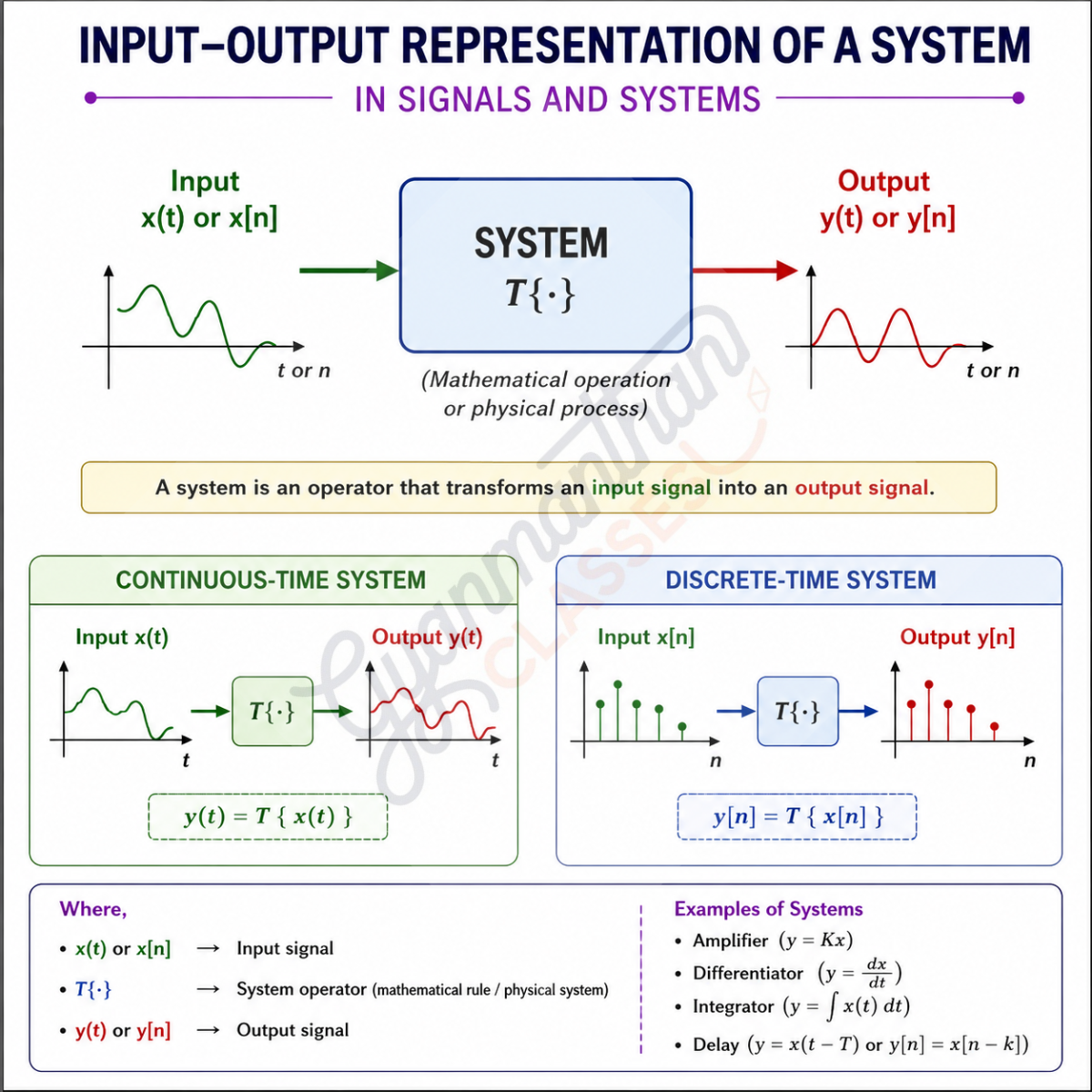
Input-Output Representation of a System
Every system establishes a relationship between the input and the output. The transformation performed by the system may involve operations such as amplification, attenuation, delay, differentiation, integration, addition, multiplication, or other mathematical manipulations.
Examples of system equations are:
Continuous-Time: $$y(t)=2x(t), \qquad y(t)=\frac{d}{dt}x(t)$$, $$\qquad y(t)=\int_{-\infty}^{t}x(\tau)\,d\tau$$
Discrete-Time: $$y[n]=x[n]+x[n-1]$$ $$\qquad y[n]=x[2n]$$
Key Observations:
- Different systems produce different outputs for the same input.
- The system equation completely defines the system behavior.
- System properties are determined from the input-output relationship.
- Most GATE questions begin with a given system equation.




Discussion / Comments