Convolution of Signals – Continuous & Discrete-Time Convolution, Properties & GATE Tricks
Convolution is one of the most important topics in Signals and Systems for GATE ECE. It is used to determine the output of Linear Time-Invariant (LTI) systems from a given input and impulse response. Learn continuous-time and discrete-time convolution, graphical convolution, important properties, solved examples, and GATE exam tricks with clear explanations.
Convolution of Signals
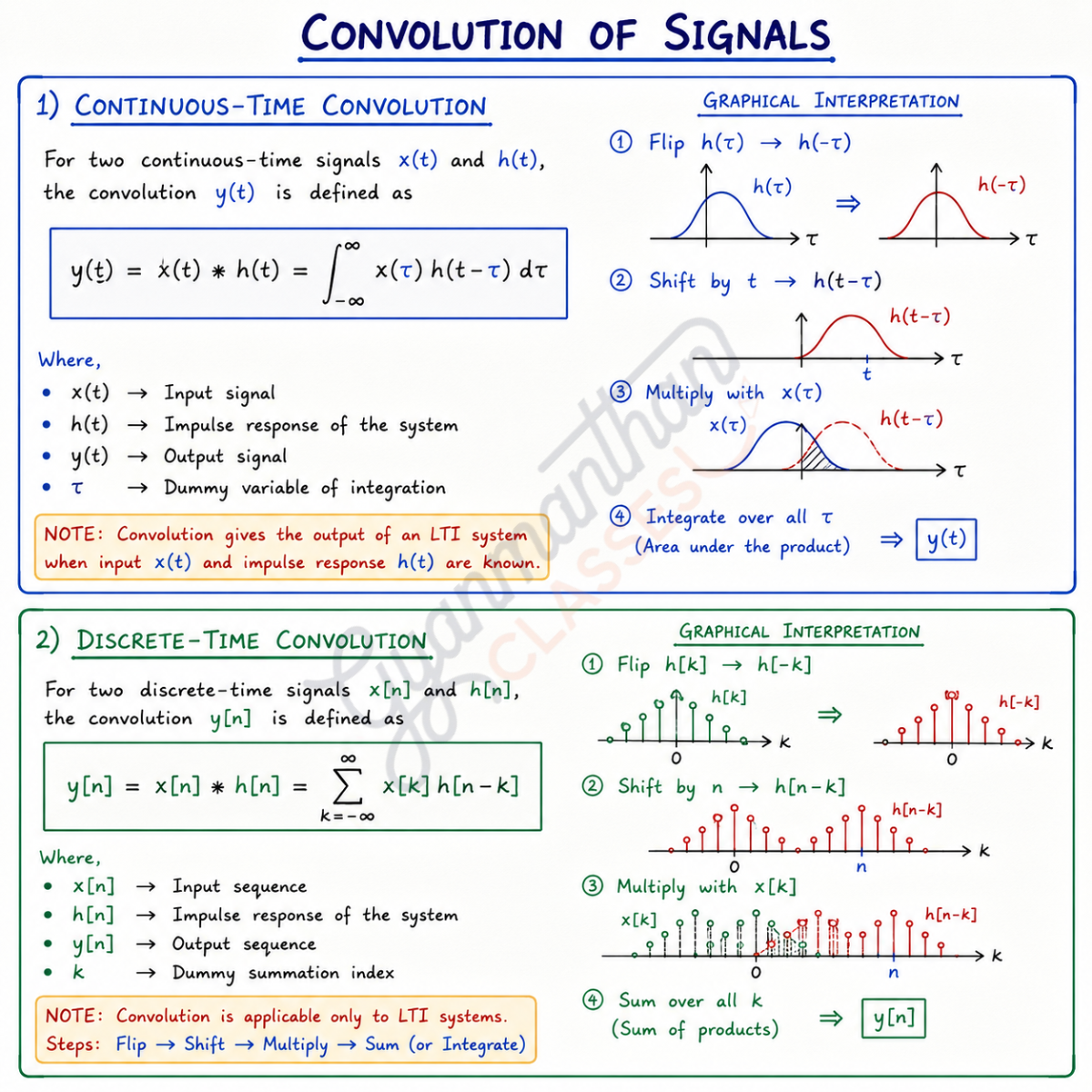
Convolution is the mathematical operation used to determine the output of a Linear Time-Invariant (LTI) system when the input signal and the system's impulse response are known.
If x(t) is the input signal and h(t) is the impulse response of the system, then the output y(t) is obtained by convolving them.
Continuous-Time Convolution
For continuous-time signals,
$ y(t)=x(t)*h(t)=\int_{-\infty}^{\infty}x(\tau)\,h(t-\tau)\,d\tau $- $x(t)$ → Input signal
- $h(t)$ → Impulse response
- $y(t)$ → Output signal
- $\tau$ → Dummy variable of integration
Discrete-Time Convolution
For discrete-time signals,
$ y[n]=x[n]*h[n]=\sum_{k=-\infty}^{\infty}x[k]\,h[n-k] $- $x[n]$ → Input sequence
- $h[n]$ → Impulse response
- $y[n]$ → Output sequence
- $k$ → Dummy summation index
⚠️ GATE Tip: Convolution is applicable only to LTI systems. Always remember the sequence: Flip → Shift → Multiply → Integrate (or Sum).
Important Properties of Convolution
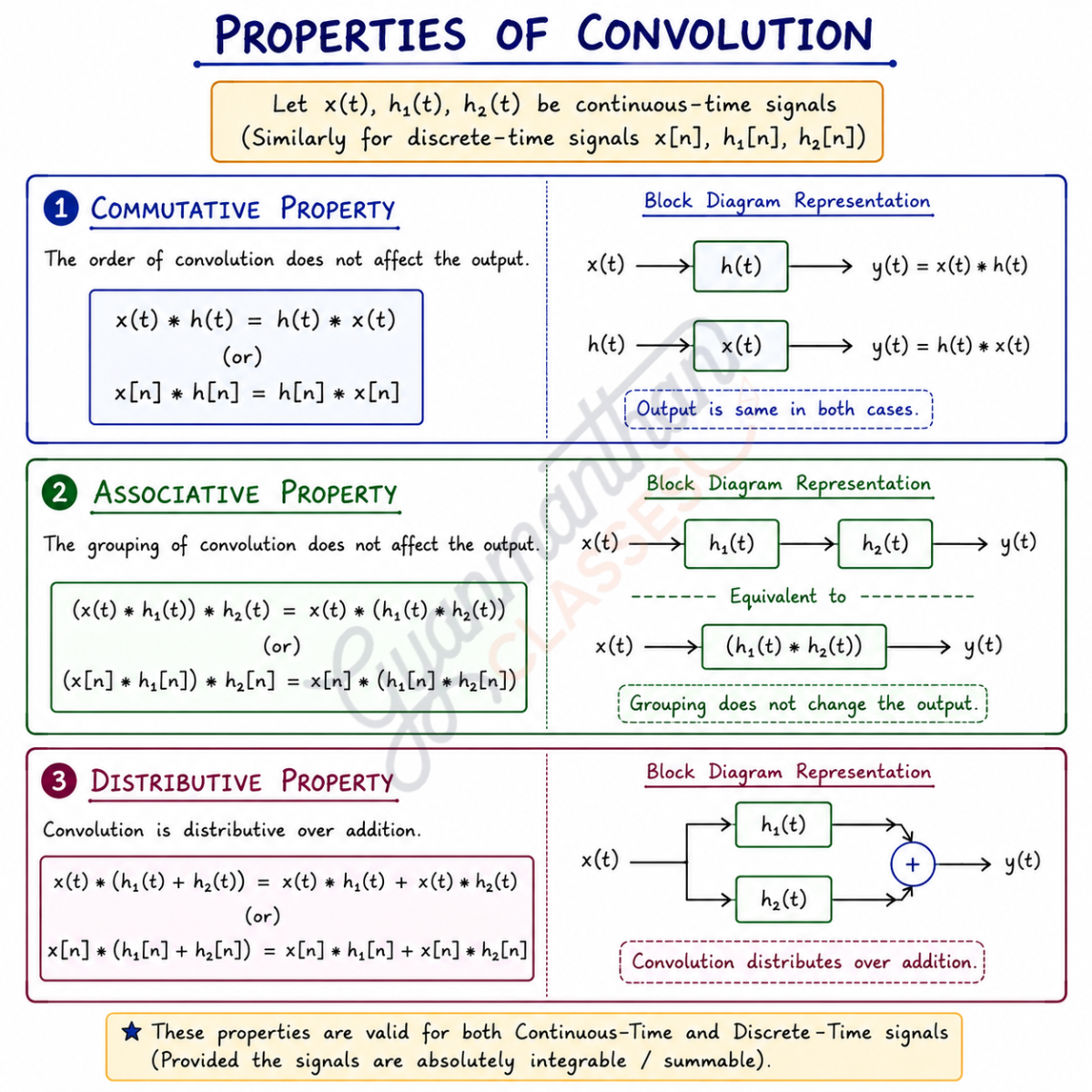
- Commutative Property: The order of convolution does not affect the output.
- Associative Property: Convolution of multiple signals can be performed in any grouping.
- Distributive Property: Convolution distributes over signal addition.
| Property | Formula | Importance in GATE |
|---|---|---|
| Commutative | $x*h=h*x$ | Allows swapping input and impulse response to simplify calculations. |
| Associative | $(x*h_1)*h_2=x*(h_1*h_2)$ | Useful in cascaded LTI systems. |
| Distributive | $x*(h_1+h_2)=x*h_1+x*h_2$ | Simplifies convolution involving sums of signals. |
⚠️ GATE Tip: These three properties are valid only for LTI systems and are frequently used to simplify convolution problems without evaluating the complete integral or summation.
Standard Convolution Results to Remember
| Standard Result | Formula | GATE Importance |
|---|---|---|
| Delta Property | $f*\delta(t_0)=f(t-t_0)$ | Instantly evaluates convolution with an impulse. |
| Step Response | $s=u*h=\int_{-\infty}^{t}h(\tau)\,d\tau$ | Links impulse and step responses. |
| Equal Rect Pulses | $\mathrm{rect}*\mathrm{rect}=T\Lambda$ | Output is a triangular waveform. |
| Unequal Rect Pulses | Output $\rightarrow$ Trapezoid | Common graphical convolution question. |
| Quick Rules |
Lower = Sum Upper = Sum Area = Product |
Useful for support and area checking. |




Discussion / Comments