Kirchhoff's Laws | KVL & KCL for GATE ECE
Kirchhoff's Laws are fundamental tools for circuit analysis and are important topics in GATE ECE. Kirchhoff's Current Law (KCL) and Kirchhoff's Voltage Law (KVL) help us determine unknown currents and voltages and form the foundation of systematic electrical circuit analysis.
In this article, we study KCL at junctions and KVL around closed loops, along with the required sign conventions and methods for writing circuit equations. These laws provide a simple and powerful approach to analyzing electrical networks of different configurations.
The article develops an intuitive understanding of Kirchhoff's Laws and shows how to apply them correctly to solve circuit problems. The concepts, examples, and problem-solving techniques are designed specifically for GATE-level circuit and network analysis.
Keywords: Kirchhoff's Laws, Kirchhoff's Law, KVL, KCL, Kirchhoff's Voltage Law, Kirchhoff's Current Law, circuit analysis, loop analysis, junction analysis, node analysis, mesh analysis, sign convention, circuit equations, electrical networks, GATE ECE network theory
Ohm's Law and the V-I Relationship
Ohm's Law describes the relationship between voltage, current, and resistance for an ohmic element. Under constant physical conditions, the current is directly proportional to the voltage across the element.
$V=IR$
Therefore,
$I=\frac{V}{R}$
where $V$ is the voltage, $I$ is the current, and $R$ is the constant resistance.
When Does Ohm's Law Apply?
Ohm's Law applies when the V-I relationship is linear and passes through the origin. For an ideal resistor, the V-I characteristic is therefore a straight line.
$\frac{V}{I}=R=\text{constant}$
Thus, if the voltage is doubled, the current also doubles, provided the physical conditions remain unchanged.
Important Points for GATE
- Ohmic element: $V\propto I$ and $R=\frac{V}{I}$ remains constant.
- V-I characteristic: For an ideal ohmic resistor, it is a straight line passing through the origin.
- Physical conditions: The resistance may change with temperature or other conditions, so Ohm's Law is considered under constant physical conditions.
- Non-ohmic elements: Elements such as diodes have a nonlinear V-I characteristic and do not obey Ohm's Law over their complete operating range.
- Time-domain relation: For a resistor, Ohm's Law is directly written as $v(t)=Ri(t)$. Capacitors and inductors have their own time-domain relationships: $i(t)=C\frac{dv(t)}{dt}$ and $v(t)=L\frac{di(t)}{dt}$.
- s-domain relation: With zero initial conditions, the voltage-current relationship of R, L and C can be written in the impedance form $V(s)=Z(s)I(s)$, where $Z_R=R$, $Z_L=sL$, and $Z_C=\frac{1}{sC}$.
- Non-zero initial conditions: When a capacitor or inductor has stored energy initially, additional initial-condition terms appear in its s-domain voltage-current equation. Therefore, $V(s)=Z(s)I(s)$ alone is valid only under the zero-initial-condition assumption.
- Initial condition is not a restriction on the resistor: A resistor can obey $v(t)=Ri(t)$ regardless of whether its initial voltage or current is zero or non-zero.
Kirchhoff's Laws: KCL and KVL
Kirchhoff's Laws are fundamental laws used to analyze electrical circuits. They are especially useful when a circuit contains multiple branches, junctions, or loops and cannot be solved directly using Ohm's law alone.
There are two Kirchhoff's Laws:
- Kirchhoff's Current Law (KCL) — based on conservation of charge.
- Kirchhoff's Voltage Law (KVL) — based on conservation of energy.
Kirchhoff's Current Law (KCL)
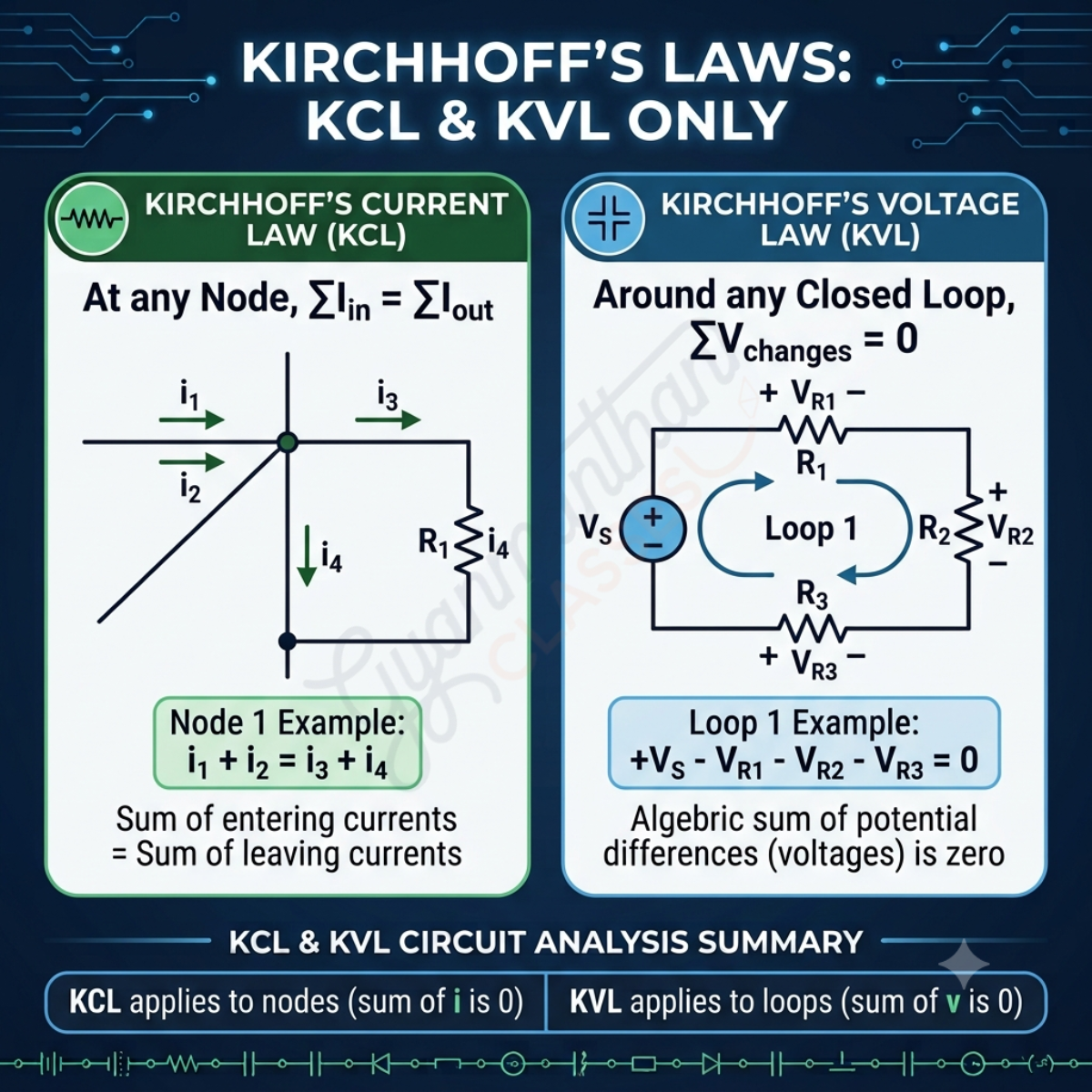
KCL states that the algebraic sum of currents at any junction is zero. Equivalently, the total current entering a junction must be equal to the total current leaving it.
$\sum i=0$
For example, if $i_1$ and $i_2$ enter a junction while $i_3$ and $i_4$ leave it:
$i_1+i_2=i_3+i_4$
KCL follows from the conservation of electric charge. Charge cannot continuously accumulate at an ideal circuit junction.
Kirchhoff's Voltage Law (KVL)
KVL states that the algebraic sum of all voltages around any closed loop is zero.
$\sum v=0$
In other words, the total voltage rises around a closed loop must be equal to the total voltage drops.
For example, if a source voltage $V$ supplies two voltage drops $V_1$ and $V_2$:
$V-V_1-V_2=0$
KVL follows from the conservation of energy. A charge returning to its starting point in a closed loop must have zero net change in energy.
Sign Convention
While applying KCL and KVL, currents and voltage changes must be assigned consistent signs. The actual direction of an unknown current does not need to be known beforehand; an assumed direction can be chosen.
If the calculated value of a current or voltage is negative, it simply means that the actual direction or polarity is opposite to the assumed one.
Key Points for GATE
- KCL is based on conservation of charge.
- KVL is based on conservation of energy.
- KCL is applied primarily at a junction or node.
- KVL is applied around a closed loop.
- For KCL, $\sum i=0$.
- For KVL, $\sum v=0$.
- Current directions and voltage polarities may be assumed initially.
- A negative calculated value indicates that the actual direction or polarity is opposite to the assumed one.
Where Do Ohm's Law, KCL and KVL Apply?
The three fundamental circuit laws have different roles in circuit analysis. This table summarizes their applicability in common GATE ECE circuit conditions.
| Law | Lumped | Distributed | Planar | Non-Planar |
|---|---|---|---|---|
| Ohm's Law | ✓ | ✓ Local relation | ✓ | ✓ |
| KCL | ✓ | ⚠ Not simple lumped form | ✓ | ✓ |
| KVL | ✓ | ⚠ Not simple lumped form | ✓ | ✓ |
GATE Note: KVL is valid for both planar and non-planar lumped circuits. However, mesh analysis is directly formulated for planar circuits.
GATE takeaway: Ohm's Law describes an element relationship, while KCL and KVL describe circuit relationships. KCL follows conservation of charge, and KVL follows conservation of energy.




Discussion / Comments