Basic Electrical Circuits & Network Theory | GATE ECE
Electrical circuits and networks form the foundation of circuit analysis and are important topics in GATE ECE. Understanding the basic electrical elements and sources is essential before studying advanced network analysis and circuit theorems.
In this article, we study the fundamental building blocks of electrical circuits, including resistors, capacitors, inductors, active and passive elements, and energy sources. We also understand the basic concepts of voltage, current, power, and energy associated with these elements.
The article provides an intuitive understanding of how different circuit elements behave, how they store or deliver energy, and how independent and dependent sources are represented in electrical networks. These concepts form the foundation for solving GATE-level circuit and network problems.
Keywords: electrical circuits, network theory, basic electrical networks, resistor, capacitor, inductor, active elements, passive elements, energy sources, voltage source, current source, independent sources, dependent sources, power, energy, circuit elements, GATE ECE network theory
Electrical circuits are built using a few fundamental elements that control, dissipate, store, or supply electrical energy. Understanding these basic elements is the first step toward analyzing electrical networks and solving circuit problems in GATE ECE.
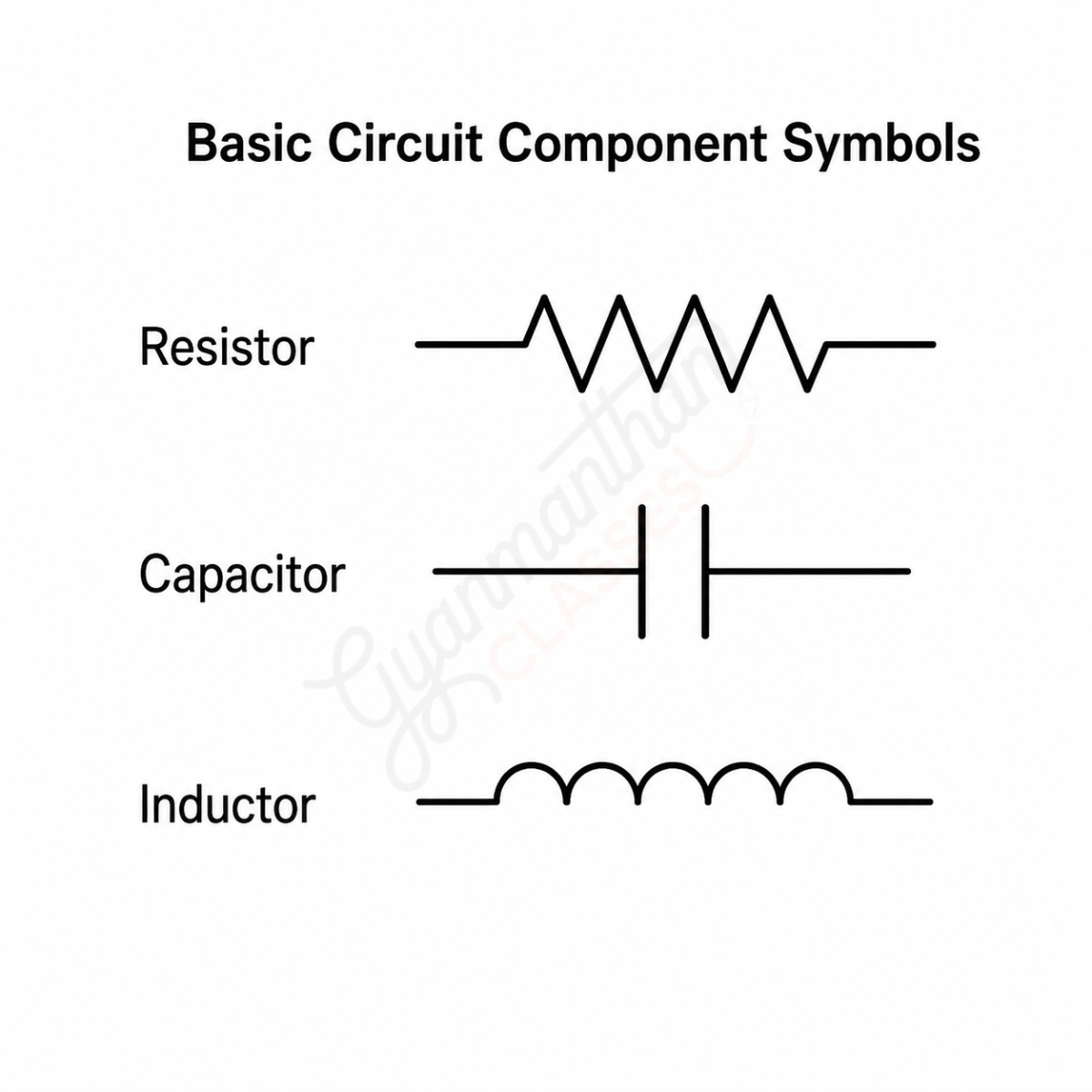
The three fundamental passive circuit elements are resistor, capacitor, and inductor. A resistor dissipates electrical energy, while a capacitor and an inductor store energy in the form of electric and magnetic fields, respectively.
Electrical networks also contain energy sources that can supply power to other elements. Sources may be classified as independent or dependent, and circuit elements can be classified as active or passive based on their ability to deliver energy or provide power gain.
In this article, we study the symbol, voltage-current relationship, power, energy, and important characteristics of each basic element and source. These concepts form the foundation for circuit analysis and advanced topics in Network Theory.
Basic Electrical Circuit Elements
A circuit element is an idealized mathematical model used to represent the electrical behavior of a physical component. The three basic passive elements are resistor (R), capacitor (C), and inductor (L).
Each element has a characteristic relationship between voltage and current. This relationship determines how the element behaves and how it exchanges energy with the rest of the circuit.
| Element | V-I Relationship | Energy Behavior |
|---|---|---|
| Resistor | $v(t)=Ri(t)$ | Dissipates energy |
| Capacitor | $i(t)=C\frac{dv(t)}{dt}$ | Stores energy in electric field |
| Inductor | $v(t)=L\frac{di(t)}{dt}$ | Stores energy in magnetic field |
Resistor
A resistor is a passive circuit element that opposes the flow of electric current and converts electrical energy into heat.
Voltage-Current Relationship
For an ideal resistor, Ohm's law gives:
$v(t)=Ri(t)$
Therefore,
$i(t)=\frac{v(t)}{R}$
where $R$ is the resistance measured in ohms ($\Omega$).
Power in a Resistor
The instantaneous power absorbed by a resistor is:
$p(t)=v(t)i(t)$
Using $v=Ri$:
$p(t)=i^2(t)R=\frac{v^2(t)}{R}$
Since the power is always non-negative for an ideal resistor, a resistor absorbs and dissipates energy rather than storing it.
Key Points
- A resistor is a passive element.
- It dissipates electrical energy as heat.
- It does not store energy.
- For an ideal resistor, voltage and current are in phase.
- Resistance is measured in ohms ($\Omega$).
Capacitor
A capacitor is a passive circuit element that stores electrical energy in the form of an electric field.
Voltage-Current Relationship
The current-voltage relationship of a capacitor is:
$i(t)=C\frac{dv(t)}{dt}$
Equivalently,
$v(t)=\frac{1}{C}\int i(t)\,dt+v(t_0)$
where $C$ is the capacitance measured in farads (F).
Energy Stored in a Capacitor
The energy stored in a capacitor is:
$W_C=\frac{1}{2}Cv^2$
Thus, the energy stored depends on the voltage across the capacitor.
Important Properties
- A capacitor is a passive element.
- It stores energy in an electric field.
- The voltage across an ideal capacitor cannot change instantaneously.
- For DC steady state, an ideal capacitor behaves as an open circuit.
- Capacitance is measured in farads (F).
Inductor
An inductor is a passive circuit element that stores electrical energy in the form of a magnetic field.
Voltage-Current Relationship
The voltage-current relationship of an ideal inductor is:
$v(t)=L\frac{di(t)}{dt}$
where $L$ is the inductance measured in henry (H).
Energy Stored in an Inductor
The energy stored in an inductor is:
$W_L=\frac{1}{2}Li^2$
Thus, the energy stored depends on the current through the inductor.
Important Properties
- An inductor is a passive element.
- It stores energy in a magnetic field.
- The current through an ideal inductor cannot change instantaneously.
- For DC steady state, an ideal inductor behaves as a short circuit.
- Inductance is measured in henry (H).
Active and Passive Elements
Circuit elements can broadly be classified as active or passive depending on their ability to supply energy or provide power gain.
Passive Elements
A passive element cannot generate net energy. It can either dissipate energy or store energy.
- Resistor: dissipates energy.
- Capacitor: stores energy in an electric field.
- Inductor: stores energy in a magnetic field.
Active Elements
An active element is capable of supplying energy to a circuit or providing power gain. Practical active devices such as transistors and operational amplifiers are examples of active devices.
Important: In basic circuit theory, ideal independent and dependent sources are generally treated as active elements because they can deliver energy to the circuit.
Energy Sources
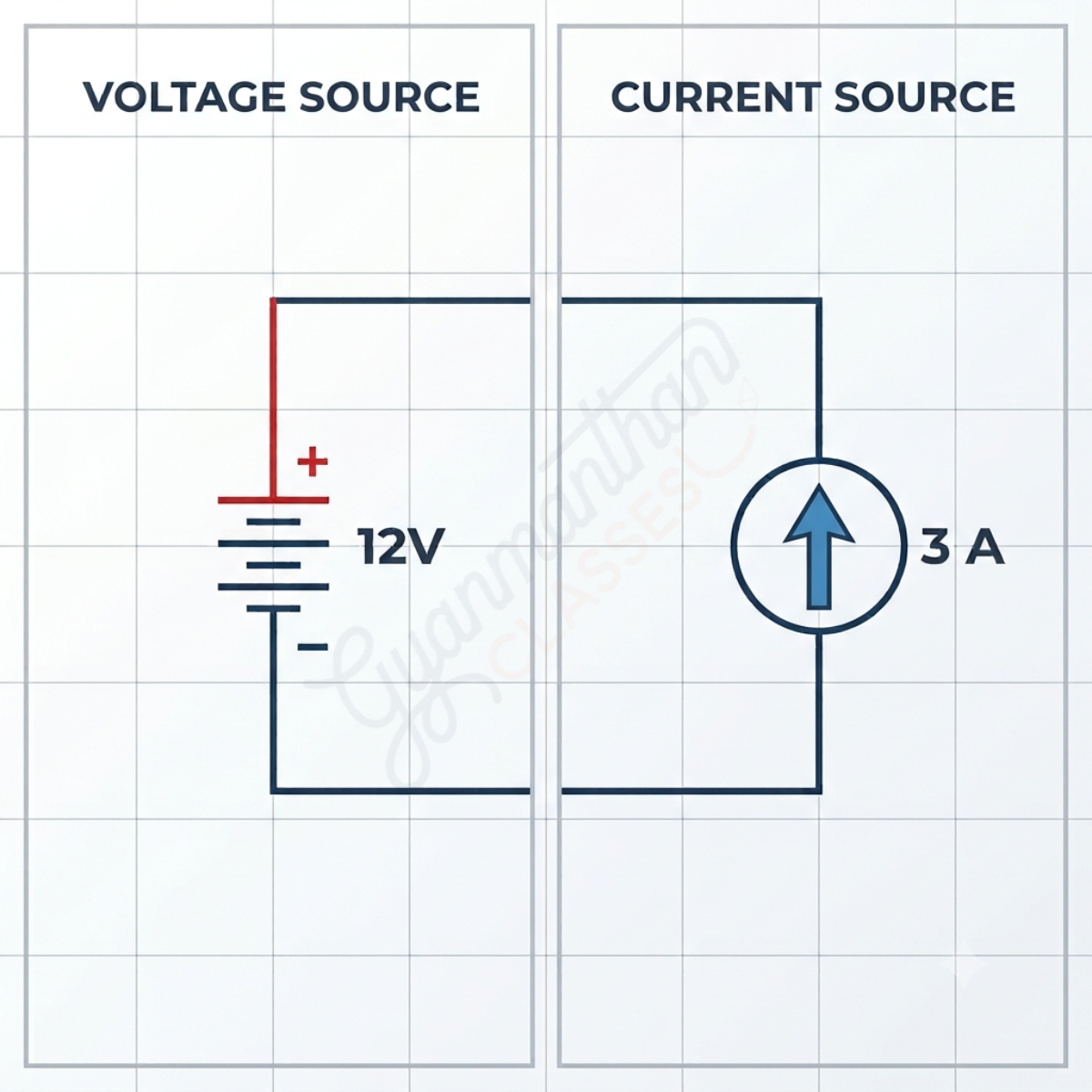
An energy source is a circuit element capable of supplying electrical energy to a network. The two fundamental types are voltage sources and current sources.
Voltage Source
An ideal voltage source maintains a specified voltage across its terminals regardless of the current through it.
$v(t)=V_s$
An ideal voltage source has zero internal resistance.
Current Source
An ideal current source maintains a specified current through its terminals regardless of the voltage across it.
$i(t)=I_s$
An ideal current source has infinite internal resistance.
Independent and Dependent Sources
Independent Source
An independent source provides a voltage or current whose value does not depend on any other circuit variable.
- Independent voltage source
- Independent current source
Dependent Source
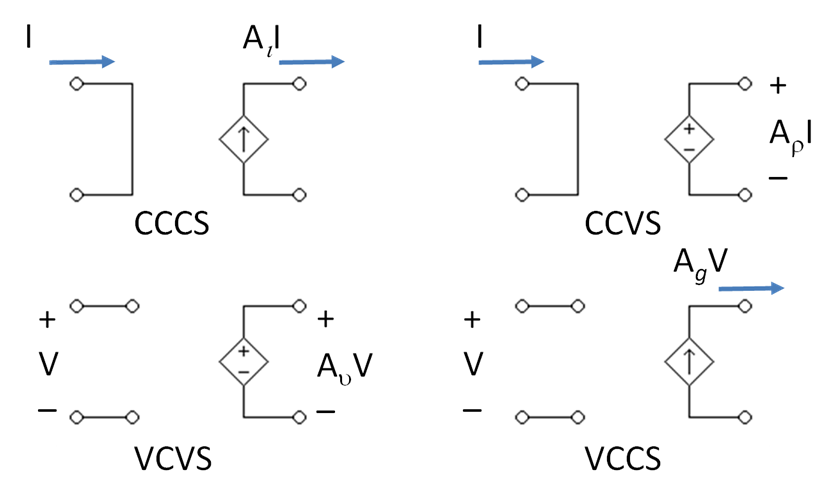
A dependent source has a voltage or current whose value is controlled by another voltage or current in the circuit.
There are four types of dependent sources:
- VCVS: Voltage-Controlled Voltage Source
- VCCS: Voltage-Controlled Current Source
- CCVS: Current-Controlled Voltage Source
- CCCS: Current-Controlled Current Source
| Source | Output | Controlled By |
|---|---|---|
| VCVS | Voltage | Voltage |
| VCCS | Current | Voltage |
| CCVS | Voltage | Current |
| CCCS | Current | Current |
Source: Wikimedia Commons — Brews ohare
Power and Energy in Circuit Elements
The instantaneous power absorbed by a circuit element is defined as:
$p(t)=v(t)i(t)$
Under the passive sign convention, current enters through the terminal marked with positive voltage. In this convention:
- $p(t)>0$ → the element absorbs power.
- $p(t)<0$ → the element delivers power.
- $p(t)=0$ → no instantaneous power is absorbed or delivered.
Energy Behavior of R, L and C
| Element | Energy Behavior | Expression |
|---|---|---|
| Resistor | Dissipates energy | $p=i^2R$ |
| Capacitor | Stores energy | $W_C=\frac{1}{2}Cv^2$ |
| Inductor | Stores energy | $W_L=\frac{1}{2}Li^2$ |
R, L and C: Quick Comparison
| Property | R | C | L |
|---|---|---|---|
| V-I | $v=Ri$ | $i=C\frac{dv}{dt}$ | $v=L\frac{di}{dt}$ |
| Energy | — | Electric | Magnetic |
| DC | R | Open | Short |
| Unit | Ω | F | H |
GATE ECE Key Takeaways
- A resistor dissipates energy but does not store it.
- A capacitor stores energy in an electric field.
- An inductor stores energy in a magnetic field.
- Capacitor voltage cannot change instantaneously.
- Inductor current cannot change instantaneously.
- An ideal capacitor behaves as an open circuit in DC steady state.
- An ideal inductor behaves as a short circuit in DC steady state.
- An ideal voltage source has zero internal resistance.
- An ideal current source has infinite internal resistance.
- Independent sources do not depend on other circuit variables.
- Dependent sources are controlled by another voltage or current in the circuit.
- There are four types of dependent sources: VCVS, VCCS, CCVS and CCCS.
- Under the passive sign convention, positive power indicates power absorption.
- Negative power indicates that the element is delivering power to the circuit.
- R, L and C are fundamental passive circuit elements.




Discussion / Comments