Vectors in EMFT | GATE ECE
Vectors form the backbone of Electromagnetic Field Theory (EMFT). Almost every physical quantity like electric field, magnetic field, and flux density is represented using vectors.
Understanding vectors is not just mathematical — it is essential to visualize how fields behave in space.
Keywords: vectors EMFT, gradient divergence curl, coordinate systems EMFT, vector algebra GATE, del operator, field theory basics
What is a Vector?
A vector is a quantity that has both magnitude and direction.
Examples: Electric Field (E), Magnetic Field (H), Displacement (D)
$$ \vec{A} = A_x \hat{i} + A_y \hat{j} + A_z \hat{k} $$
Key Idea:
- Magnitude tells "how much"
- Direction tells "where"
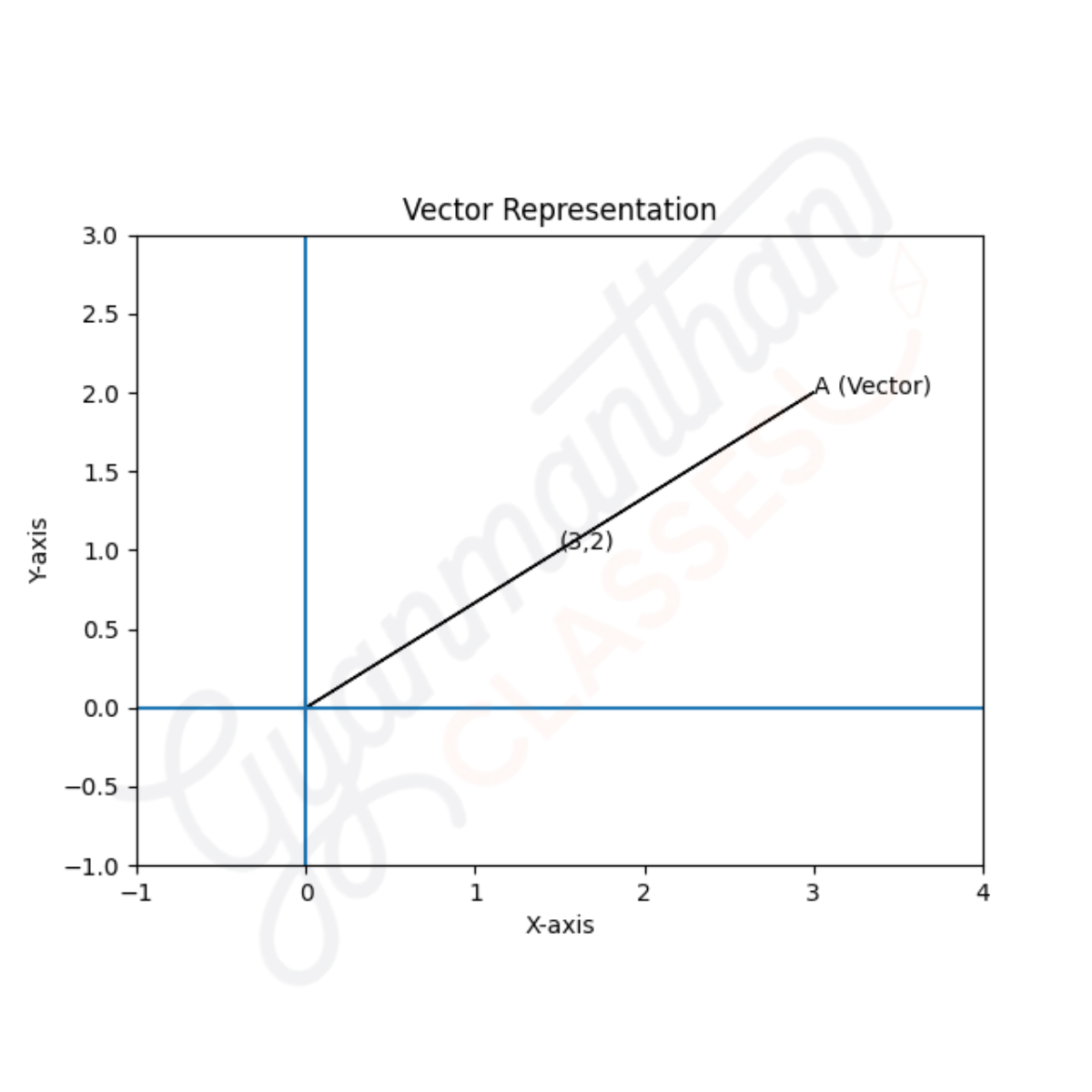
Here, x=3 and y=2
Types of Vectors
| Type | Meaning | Example |
|---|---|---|
| Unit Vector | Magnitude = 1 | $\hat{i}, \hat{j}, \hat{k}$ |
| Position Vector | Vector Form | $\vec{r} = x\hat{i}+y\hat{j}+z\hat{k}$ |
| Zero Vector | Magnitude = 0 | $\vec{0}$ |
Vector Operations
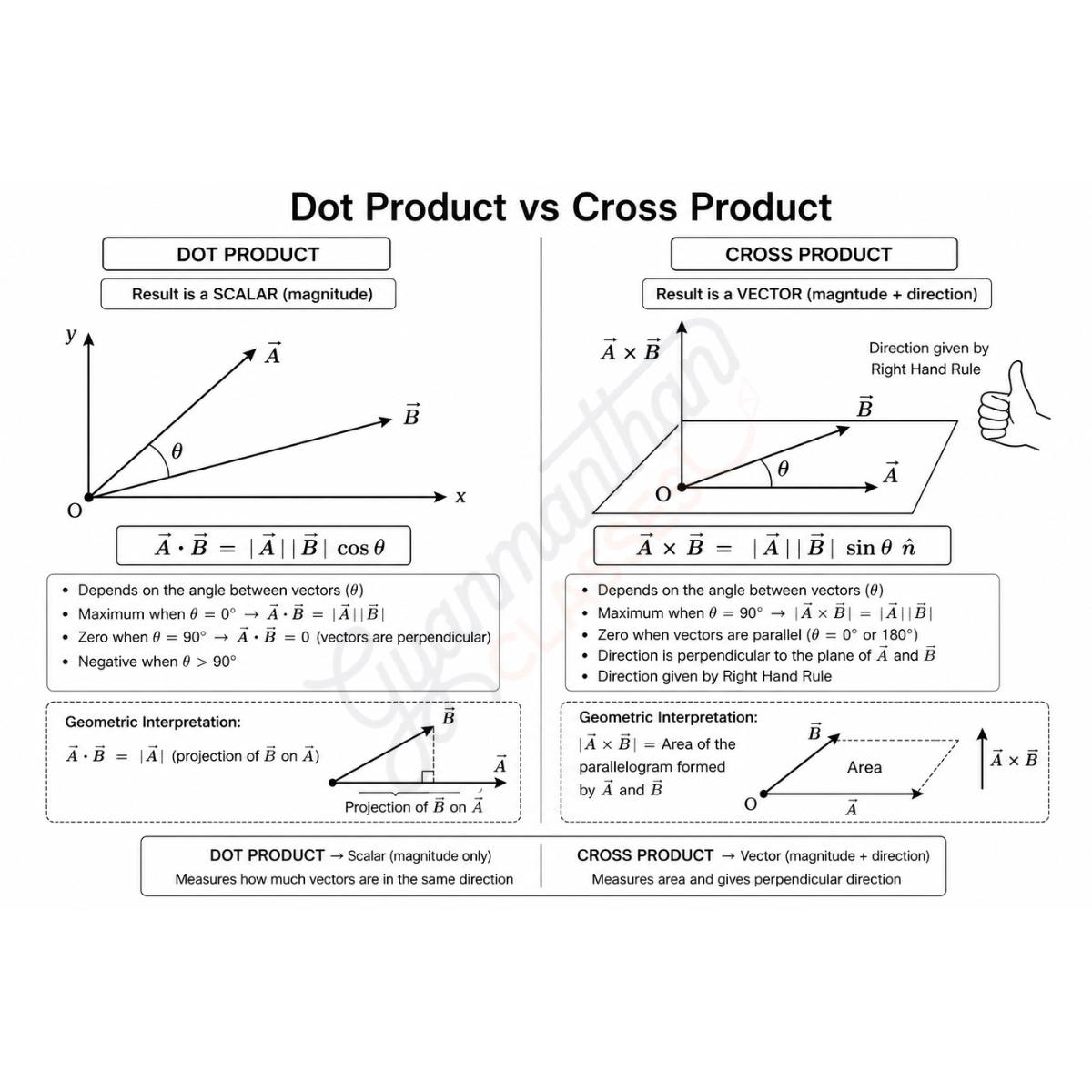
Dot Product (Scalar)
$$ \vec{A} \cdot \vec{B} = AB \cos\theta $$
- Result is scalar
- Used in work, projection
Cross Product (Vector)
$$ \vec{A} \times \vec{B} = AB \sin\theta \ \hat{n} $$
- Result is vector
- Direction by right-hand rule
Differential Operators (CORE PART)
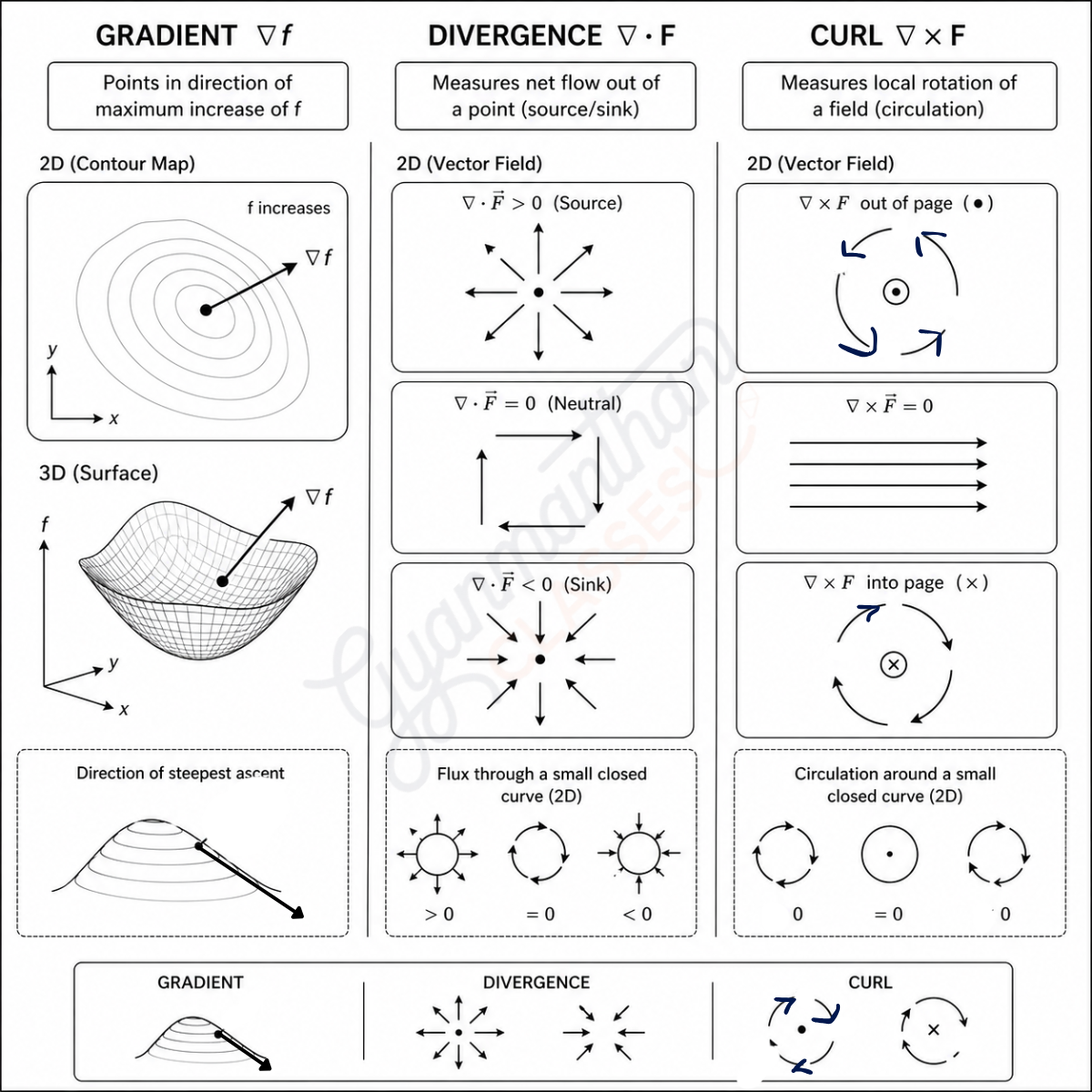
Gradient
$$ \nabla V $$
Direction of maximum increase
Divergence
$$ \nabla \cdot \vec{A} $$
Measures source or sink
Curl
$$ \nabla \times \vec{A} $$
Measures rotation
Vector Projection (Very Important)
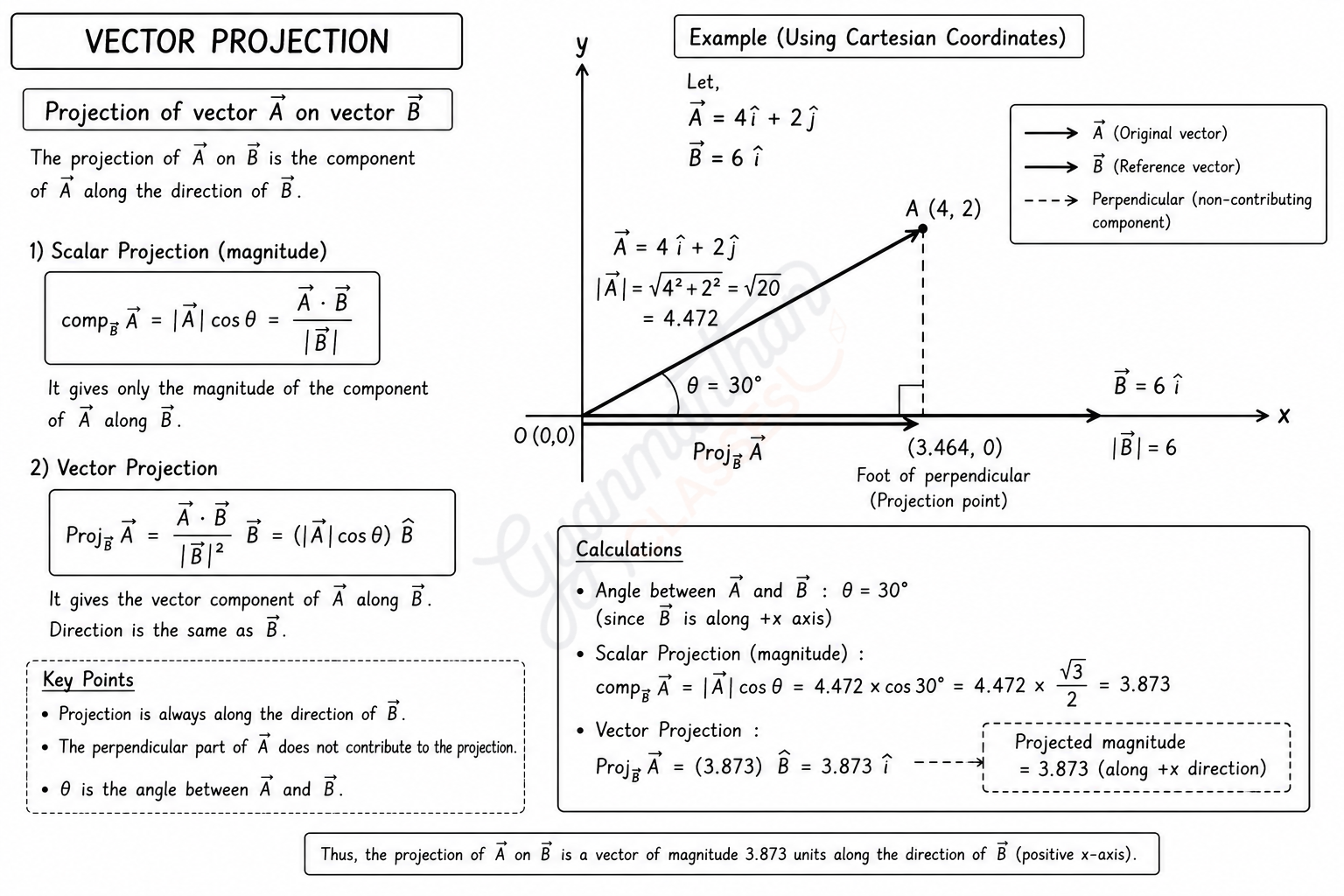
Vector projection helps us find how much of one vector lies along another vector.
Projection of $\vec{A}$ on $\vec{B}$:
Vector Form:
Key Understanding:
- Gives component of $\vec{A}$ along $\vec{B}$
- Always along direction of $\vec{B}$
- Uses dot product (cosine relation)
Physical Meaning:
- Work done = projection of force along displacement
- Only parallel component contributes
Click to zoom-in
Physical Meaning (Where Students Struggle)
| Operator | Meaning | Visualization |
|---|---|---|
| Gradient | Maximum increase | Hill slope |
| Divergence | Outflow / Source | Water spreading |
| Curl | Rotation | Whirlpool |
GATE Level Insights
- Divergence ≠ 0 → Charge present
- Curl ≠ 0 → Rotational field
- Curl = 0 → Conservative field
If $\nabla \cdot \vec{D} > 0$ → positive charge (source)
If $\nabla \cdot \vec{D} < 0$ → negative charge (sink)
Common Mistakes
- Mixing coordinate systems
- Wrong unit vectors
- Confusing divergence and curl
- Forgetting determinant in cross product
Quick Revision Trick
- Dot → Scalar → Cos
- Cross → Vector → Sin
- Grad → Increase
- Div → Outflow
- Curl → Rotation
Mini Practice (GATE Level)
Q: If $\vec{A} = x\hat{i} + y\hat{j} + z\hat{k}$, find divergence.
Solution:
$$ \nabla \cdot \vec{A} = \frac{\partial x}{\partial x} + \frac{\partial y}{\partial y} + \frac{\partial z}{\partial z} = 3 $$




Next: Coordinate Systems (Cartesian, Cylindrical & Spherical)
Discussion / Comments