Gauss’s Law in Electrostatics | Electric Flux & Gaussian Surface (GATE ECE EMFT)
Gauss’s Law is one of the most important laws in electrostatics that relates electric flux passing through a closed surface to the charge enclosed inside it.
This law simplifies electric field calculations for highly symmetric charge distributions like spheres, cylinders, and infinite planes. It is a very important topic for GATE ECE EMFT.
Keywords: Gauss law EMFT, electric flux, Gaussian surface, electrostatics symmetry, electric field using Gauss law, GATE ECE EMFT
What is Electric Flux?
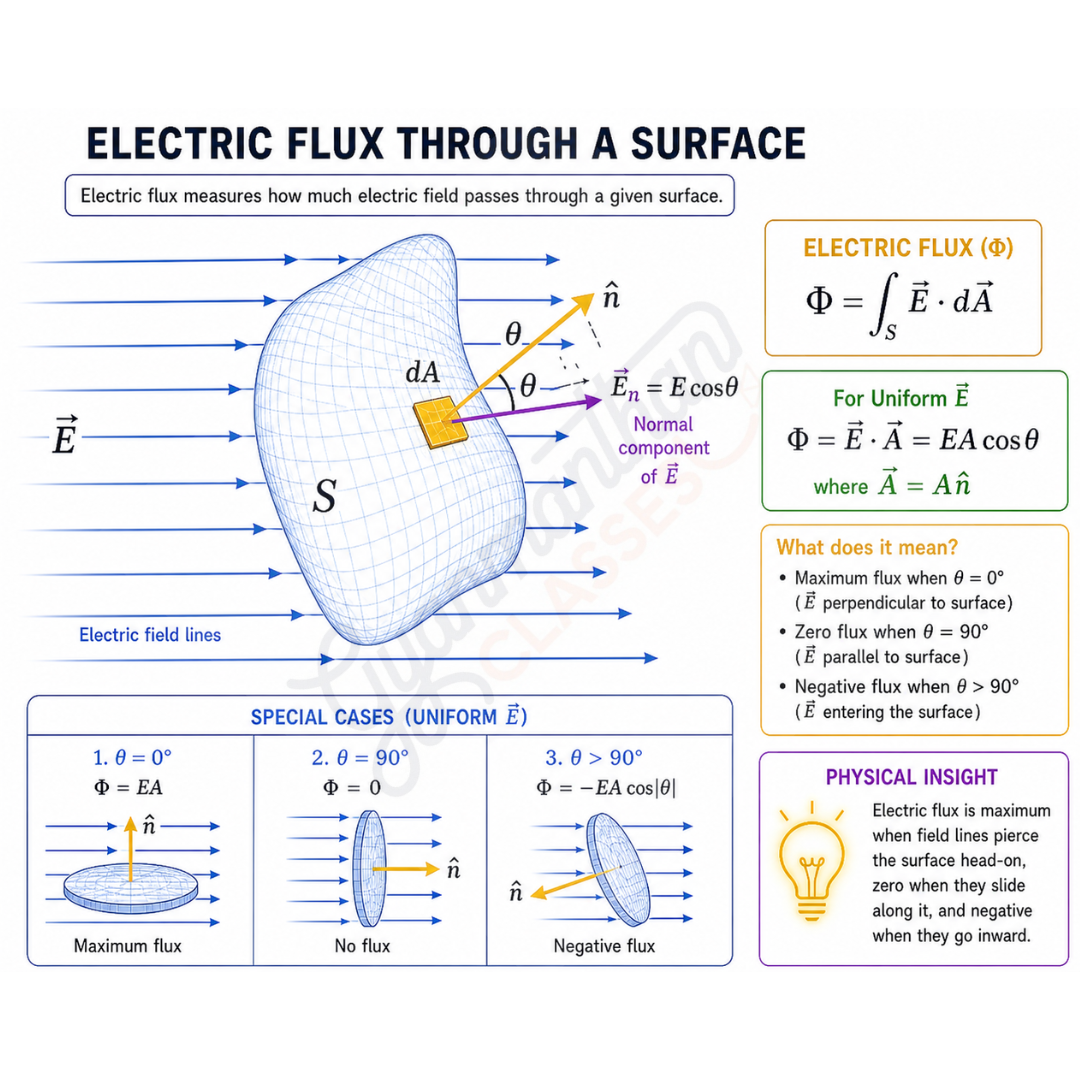
Electric flux represents the number of electric field lines passing through a surface.
If more field lines pass through the surface, flux is larger.
$$ \phi = \vec{E} \cdot \vec{A} $$
For Uniform Electric Field:
$$ \phi = EA \cos \theta $$
Key Points:
- Flux depends on electric field and area.
- Angle between field and area vector is important.
- Maximum flux occurs when θ = 0°.
Click to zoom-in
Gauss’s Law Statement
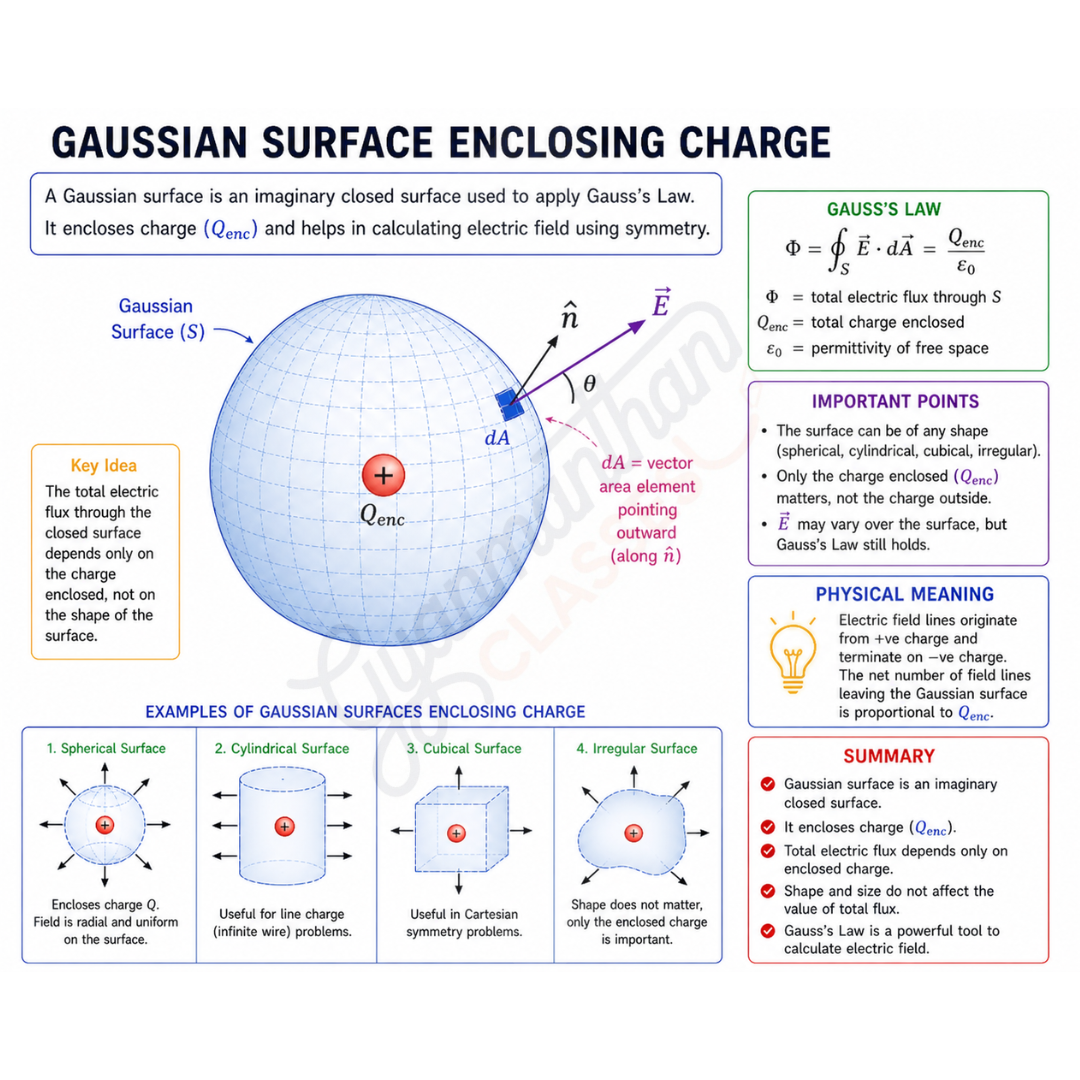
The total electric flux through any closed surface is equal to the enclosed charge divided by permittivity of free space.
$$ \oint \vec{E} \cdot d\vec{A} = \frac{Q_{enc}}{\varepsilon_0} $$
Meaning:
- Only enclosed charge contributes to net flux.
- Charges outside the surface do not affect net flux.
- The surface must be closed.
What is a Gaussian Surface?
A Gaussian surface is an imaginary closed surface chosen to simplify electric field calculations.
Why Important?
- Helps exploit symmetry.
- Makes electric field calculation easier.
- Widely used for sphere, cylinder and plane symmetry.
Common Gaussian Surfaces:
- Spherical surface
- Cylindrical surface
- Pillbox surface
Gauss’s Law for Spherical Symmetry
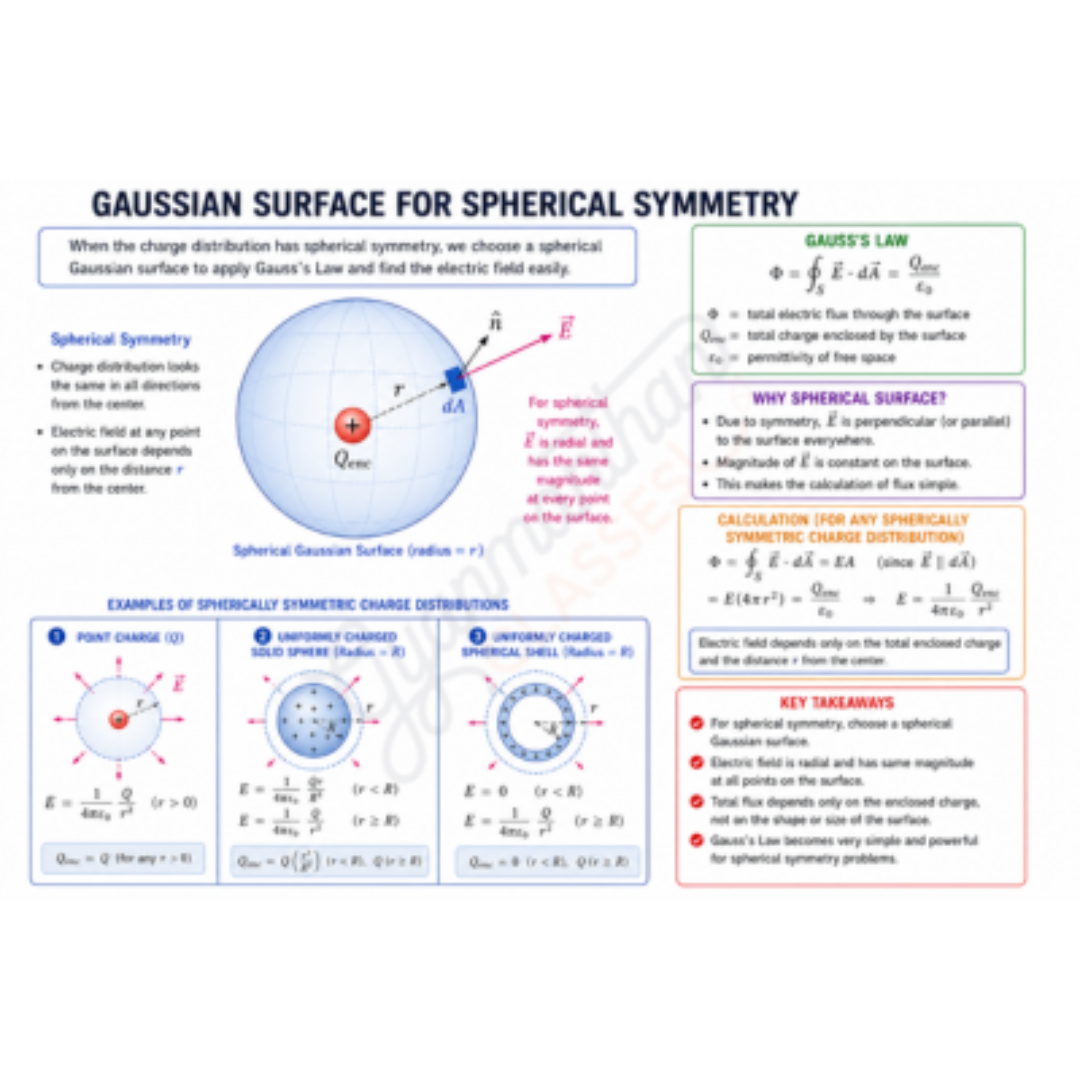
For a point charge or spherical charge distribution, electric field is same everywhere on the Gaussian sphere.
$$ E(4\pi r^2) = \frac{Q}{\varepsilon_0} $$
Final Electric Field:
$$ E = \frac{1}{4\pi\varepsilon_0}\frac{Q}{r^2} $$
Applications:
- Point charge
- Charged conducting sphere
- Spherical shell
Gauss’s Law for Cylindrical Symmetry
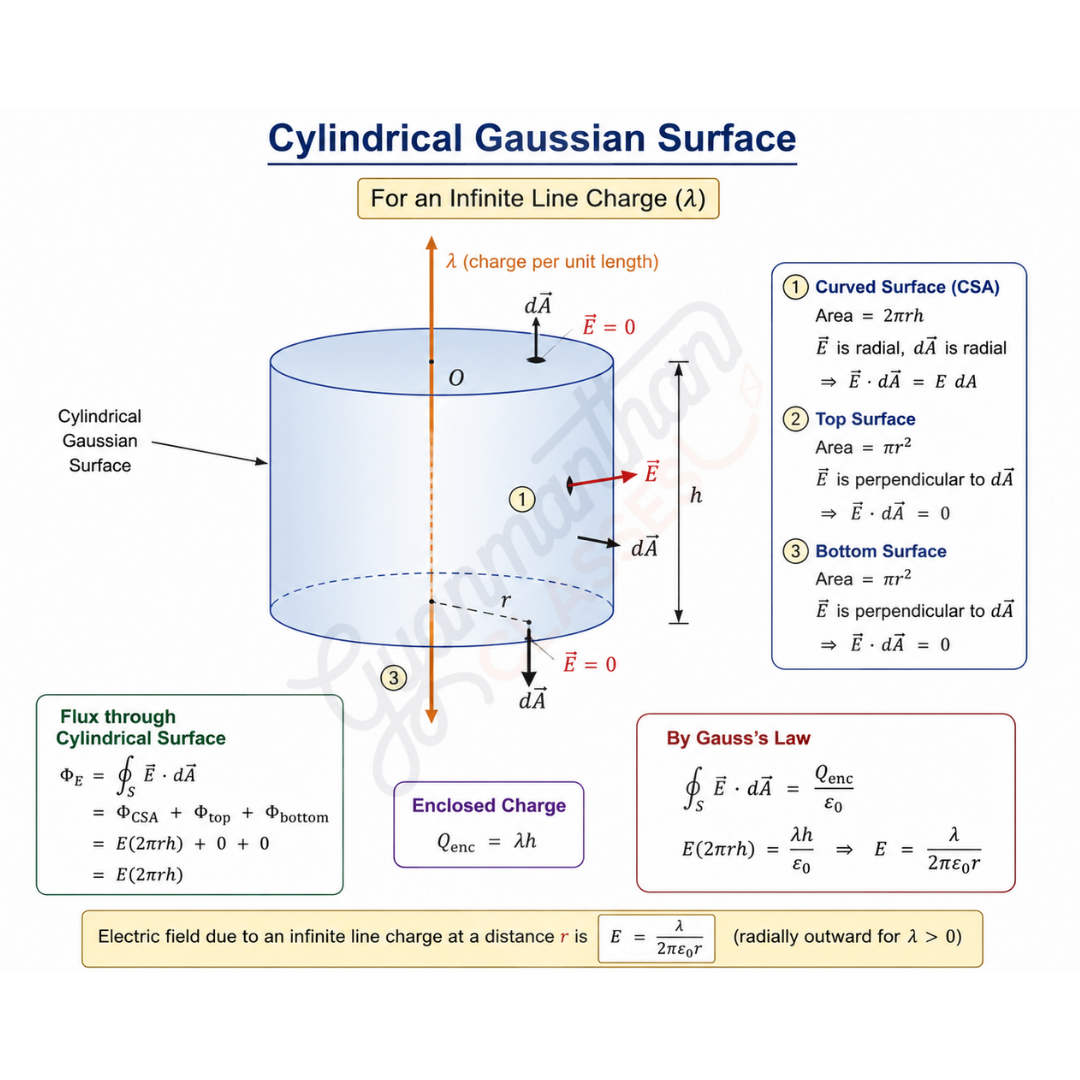
For infinitely long line charges, cylindrical Gaussian surfaces are used.
$$ E(2\pi rL) = \frac{\lambda L}{\varepsilon_0} $$
Final Electric Field:
$$ E = \frac{\lambda}{2\pi\varepsilon_0 r} $$
Applications:
- Infinite line charge
- Cables and wires
- Coaxial structures
Gauss’s Law for Infinite Plane Sheet
For infinite plane charge distributions, a pillbox Gaussian surface is used.
$$ 2EA = \frac{\sigma A}{\varepsilon_0} $$
Final Electric Field:
$$ E = \frac{\sigma}{2\varepsilon_0} $$
Key Observation:
- Electric field is constant.
- Field does not depend on distance.
Importance of Symmetry
| Charge Distribution | Symmetry | Gaussian Surface |
|---|---|---|
| Point charge | Spherical | Sphere |
| Infinite line charge | Cylindrical | Cylinder |
| Infinite plane sheet | Planar | Pillbox |
GATE Level Insights
- Choosing correct Gaussian surface is very important.
- Symmetry-based questions are common.
- Electric flux concepts are frequently asked.
- Infinite sheet and line charge derivations are important.
Common Mistakes
- Using Gauss’s Law without symmetry.
- Confusing open and closed surfaces.
- Taking outside charges in enclosed charge calculation.
- Wrong direction of area vector.
Final Summary
Gauss’s Law is one of the most powerful tools in electrostatics because it converts difficult electric field problems into simple symmetry-based calculations.
$$ \oint \vec{E} \cdot d\vec{A} = \frac{Q_{enc}}{\varepsilon_0} $$
- Electric flux measures field lines through a surface.
- Only enclosed charge contributes to net flux.
- Symmetry is the key to applying Gauss’s Law.




Discussion / Comments