Coordinate Systems in EMFT | Cartesian, Cylindrical & Spherical (GATE ECE)
In Electromagnetic Field Theory (EMFT), coordinate systems help us describe vectors and fields in space efficiently. Choosing the right coordinate system simplifies both understanding and calculations.
This chapter is extremely important for GATE because most derivations (gradient, divergence, curl) depend on coordinate systems.
Keywords: coordinate systems EMFT, Cartesian cylindrical spherical, coordinate transformation, scale factors EMFT, GATE ECE vectors
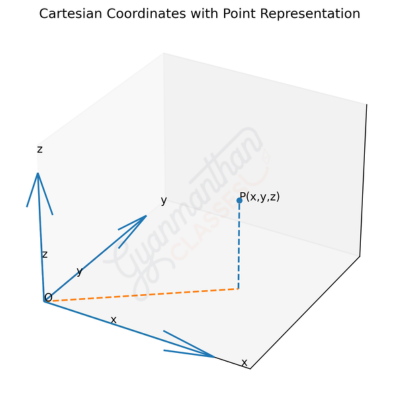
Cartesian Coordinate System
Most basic and intuitive coordinate system using x, y, z axes.
$$ \vec{A} = A_x \hat{i} + A_y \hat{j} + A_z \hat{k} $$
Key Points:
- Axes are mutually perpendicular
- Unit vectors are constant
- Simplest for rectangular geometries
Use Cases:
- Uniform fields
- Rectangular structures
Click to zoom-in
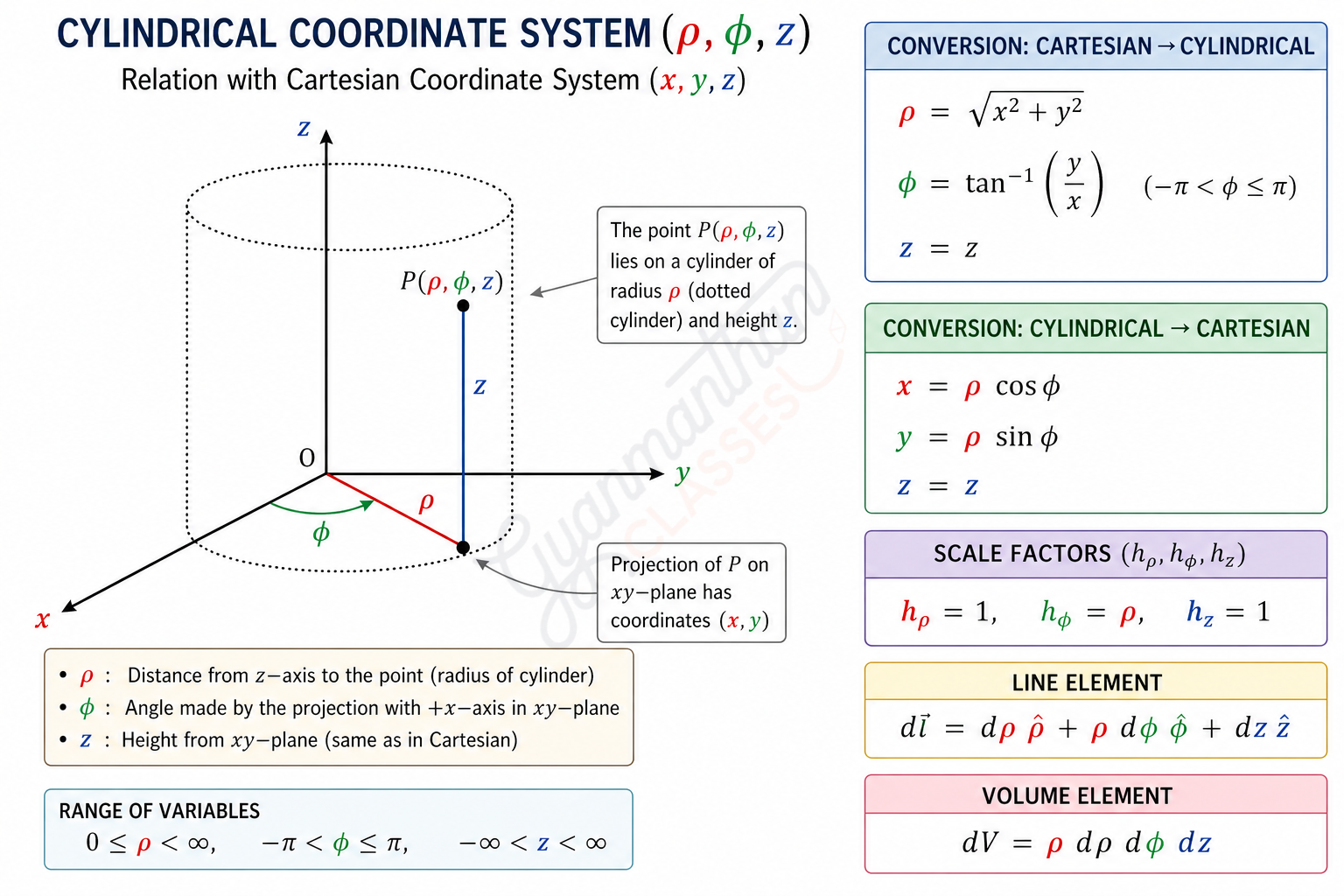
Cylindrical Coordinate System
Used when symmetry exists around an axis.
Coordinates: $(\rho, \phi, z)$
$$ \vec{A} = A_\rho \hat{\rho} + A_\phi \hat{\phi} + A_z \hat{z} $$
Key Points:
- $\rho$ → radial distance
- $\phi$ → angle in xy-plane
- $z$ → height (same as Cartesian)
Use Cases:
- Wires, cables
- Cylindrical structures
Spherical Coordinate System
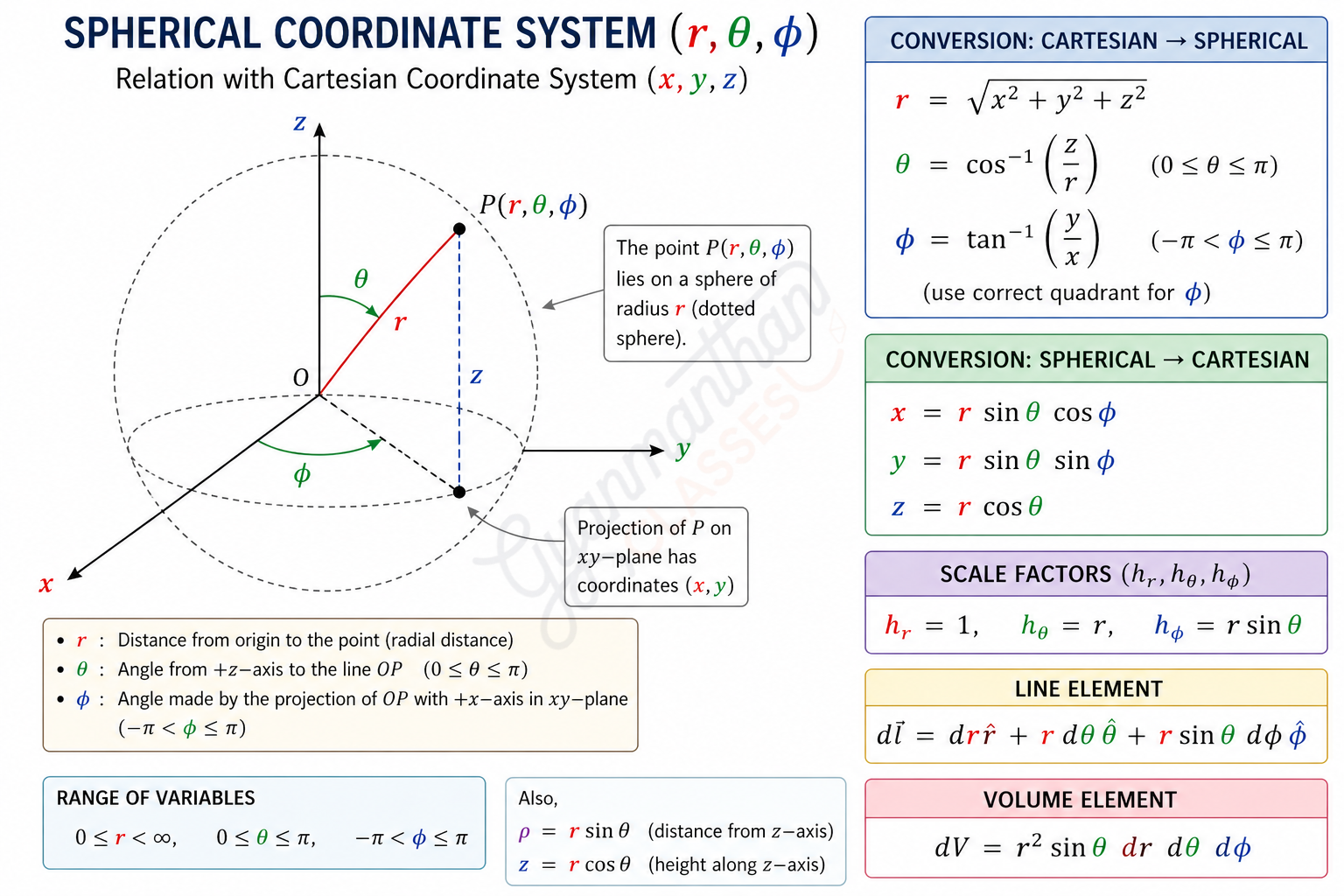
Used when symmetry exists in all directions (point-based).
Coordinates: $(r, \theta, \phi)$
$$ \vec{A} = A_r \hat{r} + A_\theta \hat{\theta} + A_\phi \hat{\phi} $$
Key Points:
- $r$ → radial distance
- $\theta$ → angle from z-axis
- $\phi$ → angle in xy-plane
Use Cases:
- Point charges
- Radiation problems
Coordinate Conversion
Cartesian ↔ Cylindrical
$$ x = \rho \cos\phi, \quad y = \rho \sin\phi $$
$$ \rho = \sqrt{x^2 + y^2}, \quad \phi = \tan^{-1}(y/x) $$
Cartesian ↔ Spherical
$$ x = r \sin\theta \cos\phi $$
$$ y = r \sin\theta \sin\phi $$
$$ z = r \cos\theta $$
$$ r = \sqrt{x^2 + y^2 + z^2} $$
Scale Factors (Metric Coefficients)
| System | h1 | h2 | h3 |
|---|---|---|---|
| Cartesian | 1 | 1 | 1 |
| Cylindrical | 1 | $\rho$ | 1 |
| Spherical | 1 | $r$ | $r\sin\theta$ |
Why important?
- Used in Gradient, Divergence, Curl
- Direct GATE questions
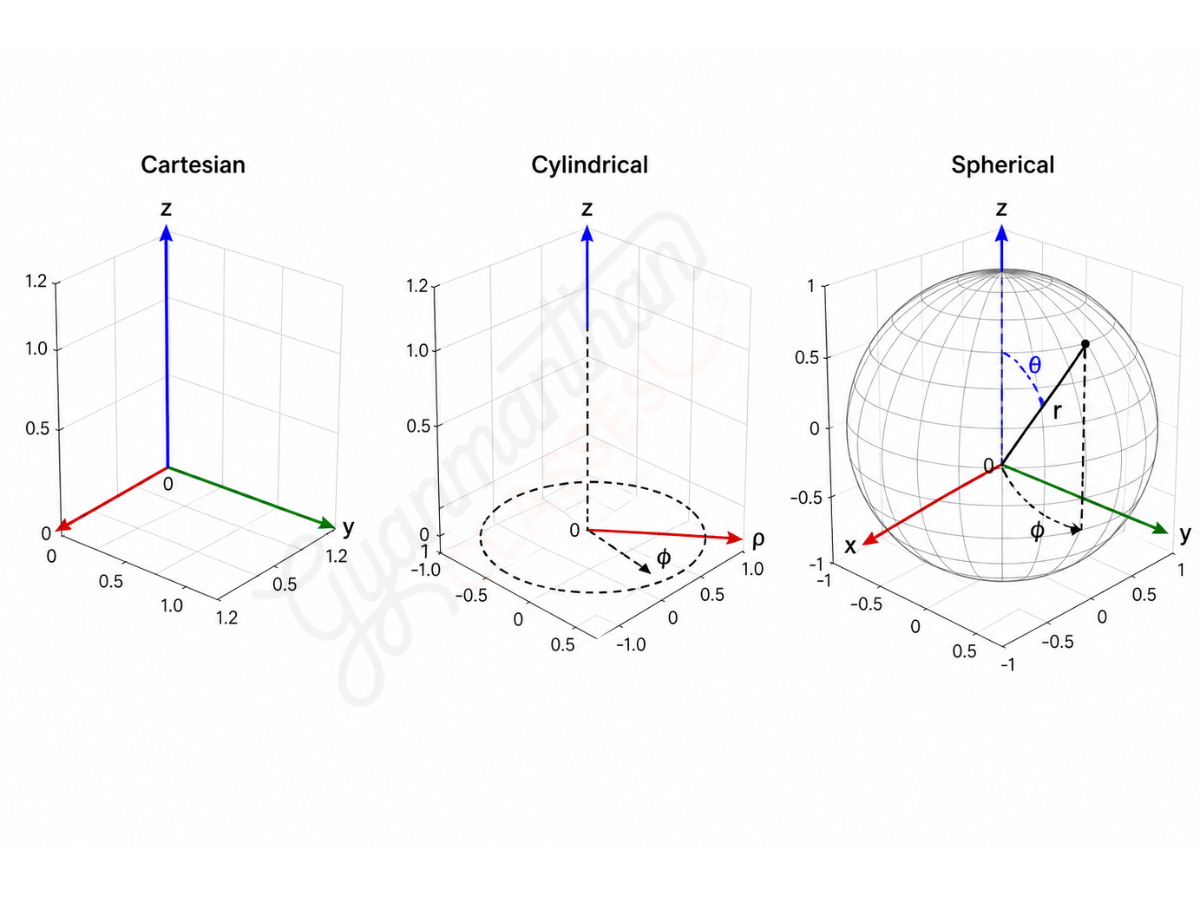
Cartesian vs Cylindrical vs Spherical
| Feature | Cartesian | Cylindrical | Spherical |
|---|---|---|---|
| Coordinates | (x, y, z) | (ρ, φ, z) | (r, θ, φ) |
| Best For | Rectangular | Wires | Point Charges |
| Complexity | Low | Medium | High |
Conclusions
Cartesian
$$ \vec{A} = A_x \hat{i} + A_y \hat{j} + A_z \hat{k} $$
Cylindrical
$$ \vec{A} = A_\rho \hat{\rho} + A_\phi \hat{\phi} + A_z \hat{z} $$
Spherical
$$ \vec{A} = A_r \hat{r} + A_\theta \hat{\theta} + A_\phi \hat{\phi} $$
- Use Cartesian for uniform fields and rectangular geometries
- Use cylindrical for wires, cables, and circular symmetry
- Use spherical for point charges and radial symmetry
GATE Level Insights
- Always choose coordinate system based on symmetry
- Scale factors are frequently asked
- Unit vectors change direction in cylindrical & spherical
- θ and φ confusion is very common
Common Mistakes
- Mixing coordinate systems
- Wrong unit vectors
- Confusing divergence and curl
- Forgetting determinant in cross product




Discussion / Comments